Amb aquest projecte no només volem millorar les dades que disposen de les dades d’aus de tota Europa sinó que també volem reforçar les polítiques com la Directiva d’Aus i l’Estratègia de Biodiversitat 2030.


WITH THE COLLABORATION OF:
Raül Aymí
Head of the Catalan Ringing Office at ICO, editorial secretary of the Catalan Journal of Ornithology and head of ICO publications.

These days, once again, swallows are arriving in Catalonia. For many people they are the symbol of spring. But what do we know about them? How do they migrate? How many years do they live? Where do those that are passing through Catalonia go? Do they return to the same nest every year? Ringing is one of the best ways to learn about how birds live and also allows us to discover small individual stories of some swallows. We tell you an example!
A swallow ringed during autumn migration at the Canal Vell Biological Station, Deltebre, on 26 September 1992 was recaptured three months later near the Boteti River, Maun, Botswana, 7,176 kilometres away.

Swallows flying over a reedbed. Image: Alba Casals
A bird with customs
The Barn Swallow is a long-distance migratory species with clear connectivity and distinct patterns. Populations breeding in western Europe are mainly connected to wintering grounds in western Africa, while more easterly populations winter in the southern half of eastern Africa.
Exceptionally, birds from the British Isles and the Norwegian west coast spend most of their winter in South Africa. The northernmost breeding populations (including the British Isles) migrate further south, mainly to South Africa. Those from the Netherlands and central Europe winter over a wide range from West Africa through the Congo to Zambia. Finally, swallows breeding in southern Europe are mainly connected to wintering grounds in Nigeria and the Central African Republic. All these journeys can be consulted on the Bird Migration Atlas portal.
YOU MAY ALSO BE INTERESTED IN
Ringing is key to understanding bird ecology
Ringing is one of the best study techniques to learn how birds live . It consists of placing a small metal ring on their leg, with a unique code to identify each individual. This way, we know where they move, how many years they live or if they return to the same places year after year.
To date, more than 130,000 swallows have been ringed in Catalonia and there are more than 400 distant recoveries of birds ringed in Catalonia and found abroad, or vice versa. In fact, Catalonia is like a "resting area" for birds, since most are populations from western Europe, mainly from France, Germany, Belgium, the Netherlands and the United Kingdom, which head towards Africa.
"Finds like this traveling swallow are very valuable because they allow us to reconstruct their migratory journeys and learn where swallow populations from all over Europe spend the winter," explains Raül Aymí , Head of the Catalan Ringing Office .
The birds ringed in Catalonia mainly winter in Nigeria where a huge dormitory is known in the town of Boje-Enyi with millions of swallows sleeping in grass fields. For some years this dormitory was exploited by the inhabitants of the village who captured around 200,000 swallows each year for their own consumption! Fortunately, measures were promoted for the conservation of this dormitory, considered the largest in Africa.
YOU MAY ALSO BE INTERESTED IN
Are swallows punctual?
Swallows usually arrive in Catalonia between the end of February and the beginning of March , but they do not always do so exactly the same. In fact, thanks to the observations collected by thousands of volunteer ornithologists on citizen science portals such as ornitho.cat , we can see how these phenological patterns vary from year to year and almost in real time! This portal has been documenting data on birds for 17 years. Here , for example, you can see how this 2026 the arrival of the species in Catalonia is being a little later than last year.

Evolution of observation frequency throughout the year (Tot). Source: Ornitho.cat
YOU MAY ALSO BE INTERESTED IN
Next challenge: documenting migrations on a European scale
One goal of the scientific community is to know in real time the migration patterns of birds in Europe. This task is being developed by the EuroBirdPortal (EBP) , a project of the European Bird Census Council coordinated by the ICO with the collaboration of CREAF.
Amb aquest projecte no només volem millorar les dades que disposen de les dades d’aus de tota Europa sinó que també volem reforçar les polítiques com la Directiva d’Aus i l’Estratègia de Biodiversitat 2030.
Lluís Brotons
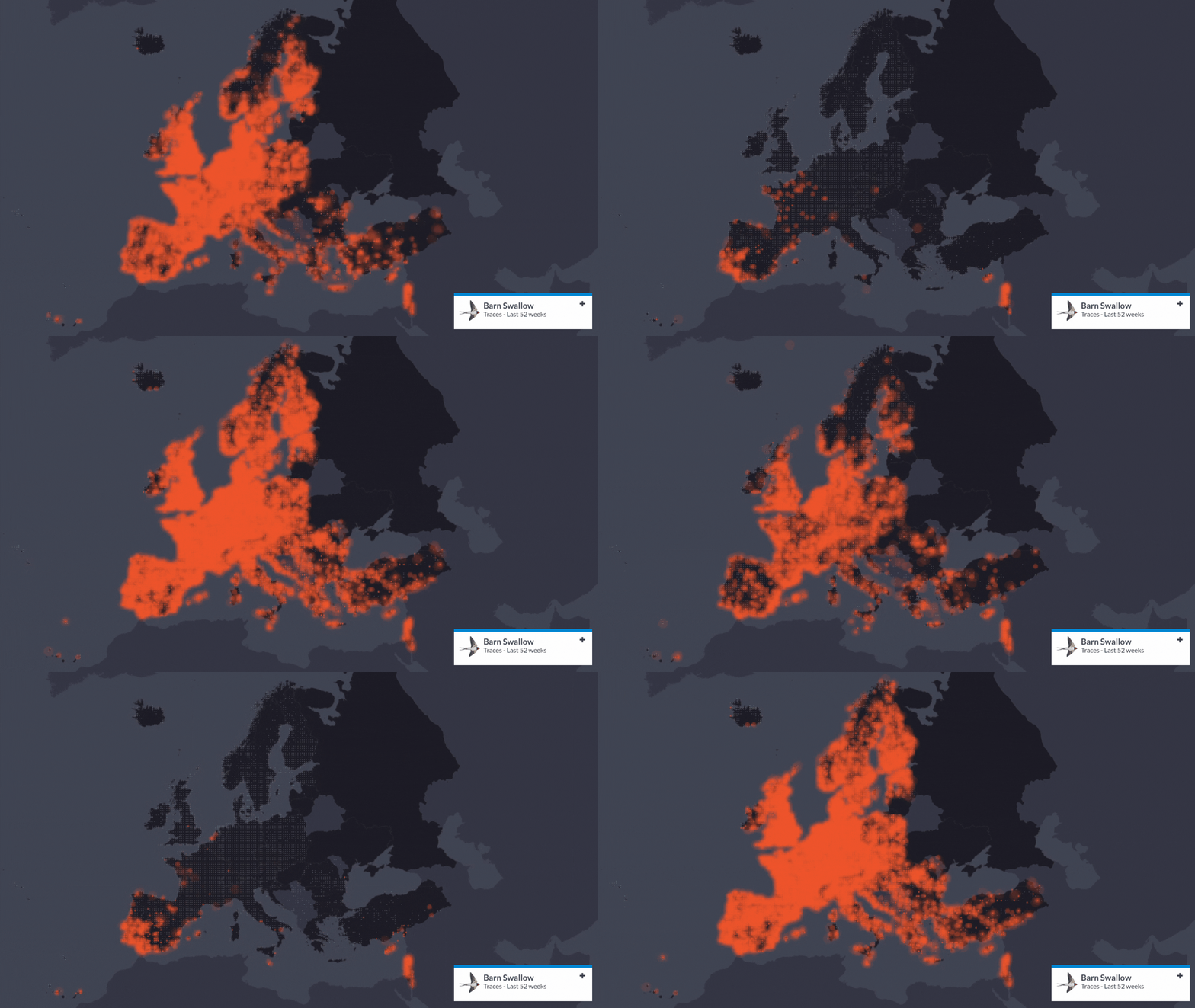
Barn swallow (Hirundo rustica) sightings from the last 52 weeks. Source: EuroBirdPortal
In parallel, CREAF is also working to improve the quantity and quality of bird data in Europe through the LIFE EBP Reinforcement project led by CSIC researcher at CREAF Lluís Brotons . “With this project we not only want to improve the data available on bird data from across Europe but also want to reinforce policies such as the Birds Directive and the Biodiversity Strategy 2030,” explains the researcher.
The collaboration between the Catalan Institute of Ornithology and CREAF is key to advancing knowledge of birds and their migrations. "We are bringing together expertise to better study birds, data management to have a more complete and rigorous vision of their ecology," concludes Sergi Herrando , a researcher at CREAF and ICO.

El CREAF i l'ICO sumem experteses per estudiar millor els ocells, la gestió de dades per tenir una visió més completa i rigorosa de la seva ecologia
Sergi Herrando
AMB LA COL·LABORACIÓ DE: