What are the effects of rainfall after a wildfire?
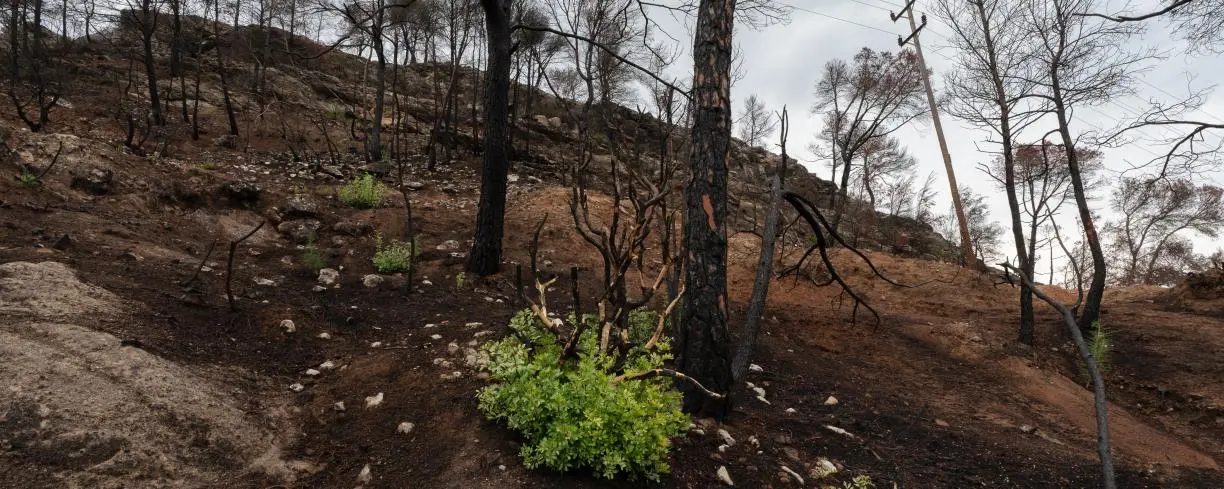

When a forest burns, the landscape changes radically. In some cases, the transformation is so striking that the fire 'uncovers' landscape features that were previously hidden, such as old terraces or dry-stone walls. Vegetation vanishes, leaving the soil bare and unprotected—and consequently, far more vulnerable to erosion. Amidst the many uncertainties left in the wake of a fire, one concern becomes particularly pressing as autumn approaches. What will happen if there is heavy rainfall in the coming days or months?
Torrential rains accelerate soil erosion
Torrential rains accelerate soil erosion
When heavy rain falls on a burnt forest, there is a risk of soil erosion, with consequences affecting the entire ecosystem. On one hand, the fact that the soil is left completely exposed —devoid of vegetation— makes it more vulnerable to the impact of raindrops, which break apart soil particles and reduce porosity. On the other hand, bare soil cannot absorb all the rainwater; consequently, the water flows across the surface as runoff. This effect is further intensified if the fire reached very high temperatures, as the heat alters soil properties and can create a hydrophobic layer —a layer that repels water and prevents infiltration. Furthermore, runoff is more intense in areas with steep slopes.
Under these conditions, rainwater washes away a significant portion of the topsoil —the layer richest in nutrients and organic matter, and where large quantities of ash, sediment, and soil particles accumulate. As a result, the soil loses fertility and its capacity to retain water and nutrients; additionally, organisms inhabiting this layer—such as fungi, bacteria, and invertebrates—are harmed, as are plants, which lose the substrate where they take root and obtain nutrients. Additional impacts include the erosion process washing away the seeds of certain plants —such as rockroses (Cistus spp.)— that were buried and typically germinate after a fire. Furthermore, runoff can sweep away pine nuts deposited on the soil surface after being released from cones during the blaze, thereby further compromising the vegetation's natural regeneration capacity.

Ashes contain many nutrients. Image: Galdric Mossoll
TAMBÉ ET POT INTERESSAR
TAMBÉ ET POT INTERESSAR

The top priority: protecting the soil
The top priority: protecting the soil
After a fire, it is necessary to assess the condition of the soil and the forest. During this phase —usually carried out by the authorities— areas most vulnerable to erosion can be identified based on factors such as soil type, terrain topography, or fire severity (i.e., the extent of fire damage to the vegetation).
Consequently, when there is a risk of erosion, rapid action is required before the rains arrive to implement appropriate post-fire management that minimizes this risk. These actions fall within the so-called "emergency phase," which takes place during the first year following the fire.
During this phase, interventions must be carefully planned to avoid the opposite effect; the soil is particularly vulnerable, so introducing heavy machinery or allowing livestock to graze immediately is ill-advised. Furthermore, priority must be given to sloped areas or those most severely affected by the fire, due to their higher erosion risk. Ultimately, the main objective is twofold: to prevent soil degradation caused by erosion while simultaneously aiding ecosystem recovery.

Sloping areas are at greater risk of erosion. Image: Galdric Mossoll
Measures to reduce erosion after a fire:
Measures to reduce erosion after a fire:
- Leave the burned soil undisturbed: immediately after a fire, it may seem necessary to remove burnt materials or ash, but this is not recommended. Ash consists of mineral salts and nutrients from the burnt vegetation —such as calcium, potassium, magnesium, phosphorus, trace elements, and minerals— which can nourish the first plants to grow during the regeneration process. It also contains nitrogen, albeit to a lesser extent and only in the short term, as much is lost during combustion. Furthermore, partially burnt plant debris, such as pine needles or leaves, forms a "natural blanket" that protects the soil from the direct impact of rain and slows down runoff.
- Cover the ground with natural materials: one of the most common techniques is creating a protective layer over the soil, known as mulching. This involves spreading straw, wood chips, or other plant materials from the local area to mitigate runoff and prevent rain from washing away the topsoil.
- Remove certain burnt trees when necessary: severely damaged trees can break and fall, posing a risk to people, especially in frequently visited areas.
- Use trunks and crown debris to stabilize the terrain: felled burnt trees can be arranged on slopes to form terraces, acting as small barriers that slow the flow of water and trap eroded sediment at higher elevations. Furthermore, burnt wood provides nutrients as it decomposes, creates a favourable microclimate for seedlings, protects them from herbivores, and serves as a refuge for seed-dispersing animals. It also promotes a faster recovery of the forest and its carbon-sequestration capacity.
- Building barriers to slow water flow: in addition to placing tree trunks on the ground, small structures such as walls, check dams, or dry-stone terraces can be added to slow the water and retain sediment.

Pine needles cover the ground and protect it. Image: Galdric Mossoll

Pine needles are beneficial for protecting the soil. Image: Galdric Mossoll

Placing trunks and branches in the form of terraces helps stabilize the soil. Example in the Bellprat fire of 2021. Image: Galdric Mossoll
Why does one soil erode more than another?
Why does one soil erode more than another?
Not all soils react the same way after a fire. Soil composition plays a role. Silty or clayey soils are more susceptible to erosion because they are compacted, lack porosity, and contain little organic matter. This prevents rainwater from infiltrating quickly, causing it to flow across the surface instead. In contrast, sandy soils and clayey soils with good organic matter content create pore spaces that allow water to infiltrate and be retained, offering greater resistance to sediment runoff.
Topography also plays a significant part. On sloping terrain, water flows faster and has a greater capacity to carry away soil particles, creating rills, gullies, or even small ravines following heavy rainfall.
Finally, the intensity of the fire is a key factor. Severe fires can consume almost all vegetation and the layer of organic debris that protects the soil. The more exposed the land becomes, the more vulnerable it is to erosion.
TAMBÉ ET POT INTERESSAR
TAMBÉ ET POT INTERESSAR

Rivers and reservoirs can become contaminated
Rivers and reservoirs can become contaminated
After a fire, rainfall can wash soil and ash into rivers and reservoirs as sediment, making the water turbid and altering its quality. Furthermore, a massive influx of nutrients can trigger eutrophication—an excessive proliferation of algae that depletes the oxygen available in the water for other organisms. Furthermore, the effects are not limited to the burned area. Since forests are part of interconnected watersheds, rain-washed sediments can reach distant areas and even contribute to the siltation of rivers and reservoirs—that is, the progressive accumulation of sediment on the riverbed or reservoir floor—thereby reducing their depth and water storage capacity.

During the rains, small torrents can form and carry ash to rivers and reservoirs. Image: Galdric Mossoll
Can the land use of burned land be changed?
Can the land use of burned land be changed?
In general, legislation establishes limitations to prevent fires from being used as a tool to force changes in land use. Specifically in Spain, the Article 50 of the Forestry Law (Law 43/2003 of November 21), titled "Maintenance and restoration of the forest character of burned lands," prohibits changing the land's forest status for 30 years.
During this period, the area must retain its forest character, and permitted activities must be compatible with ecosystem recovery and comply with regional regulations. For example, actions outlined in the restoration plan or certain forestry operations may be carried out, provided they do not compromise forest regeneration and comply with current regulations.
On the other hand, recreational use is generally not prohibited, although it may be temporarily restricted for safety reasons. Similarly, grazing may be permitted after a few years or restricted depending on the autonomous region and the area's recovery needs —particularly when there is a risk that it might hinder the restoration of vegetation and soil.
However, there are exceptions where converting the land to agricultural use is viable, especially if the change aims to create landscapes that are more resilient to forest fires. For instance, CREAF has worked on various projects to create open spaces for agriculture, employing practices that foster herbaceous cover and woody crops. The overall goal is to create a mosaic landscape—an interspersion of forest and agricultural areas that acts as a natural firebreak. One such project is "The Green Link," which involved interventions in the Òdena area (burned in 2015) using the Cocoon technique to replant the site with olive and holm oak trees. Another ongoing project is RESTARC, a joint initiative with the Catalan Waste Agency aimed at promoting the use of soil amendments and organic waste to restore degraded soils.

Burned forests cannot have their land use changed for 30 years, except in some cases to make the forests more resilient. Image: Galdric Mossoll

The planet is losing soil
The planet is losing soil
Major forest fires are becoming increasingly frequent and intense; the main consequence is that our forests will become less capable of recovering from erosion. According to a study by CREAF and the CTFC, if current trends continue, soil loss in the Mediterranean region could increase by up to 150% by 2050. This represents a shift from the current annual loss of 15–16 tonnes of soil per hectare to over 40 tonnes per hectare per year.
The same study warned that soil loss also has direct effects on the climate. Following a forest fire, the soil’s role can flip: instead of acting as a carbon sink, it becomes a carbon source. This occurs because eroded soil loses some of its carbon storage capacity and may release some of that carbon into the atmosphere as CO₂. Consequently, an ecosystem that once helped mitigate climate change begins to contribute to it. This effect can trigger a feedback loop, as increased emissions foster a hotter, more extreme climate, which in turn raises the risk of further fires and intense weather events.
Nature needs time
Nature needs time
Once a few years have passed since the fire and measures to reduce soil erosion have been implemented, other actions can be taken to accelerate vegetation recovery—such as selecting sprouts, selectively thinning saplings, or carrying out replanting efforts where necessary to compensate for a lack of natural regeneration. The good news is that Mediterranean forests have evolved alongside fire, and many of their species are adapted to regenerate after a blaze. This is the case for resprouting species —such as the holm oak— which can grow back from their roots or stumps just weeks after a fire, and for seeding species —such as the Aleppo pine— which store a bank of protected seeds in their canopy cones that disperse and germinate following the fire.
However, while trees may recover within years or decades, the soil requires much more time. For instance, the Soil Conservation Service from Australia establishes a standard estimate of approximately 100 years to form a single centimeter of soil —though this rate varies significantly based on climate, rock type, and terrain characteristics, potentially taking up to 1,000 years. In areas with soft rock and a humid, temperate climate, the process is faster; conversely, in regions with hard materials and arid or cold climates, it can span over a millennium.
However, successful recovery is not always guaranteed. A forest's regeneration time depends on the severity of the fire and subsequent environmental conditions. In the context of climate change —characterized by more frequent droughts, higher temperatures, and more intense torrential rain— there is an increased risk that degraded soils will be lost before they can regenerate. That is why protecting the soil after a fire is just as important as restoring the vegetation.

A few days after a fire, some species begin to sprout. Image: Galdric Mossoll
WITH THE COLLABORATION OF:
WITH THE COLLABORATION OF:
RESEARCHER
Sara Maranon
I have a PhD in Ecology from the University of Granada (2011), and I am currently a researcher in ecology and edaphology at CREAF. I am also a full professor at the Autonomous University of Barcelona.

RESEARCHER
Vincent Carabassa
I have a doctorate in Terrestrial Ecology from the UAB, a degree in Environmental Sciences from the Autonomous University of Barcelona (2004) with a master's degree in Soil Sciences from the University of Lleida (2008).

RESEARCHER
Xavier Domene
I have a doctorate in Biology from the Autonomous University of Barcelona (UAB) and have completed postdoctoral stays at the University of Coimbra (Portugal), University of São Paulo (Brazil), Cornell University (USA) and INIA (Madrid). Since 2008 I have been a teacher at the Ecology Unit in Soil Science and Ecotoxicology and a researcher at CREAF.

RESEARCHER
Josep Maria Espelta
Doctor in Biological Sciences (UAB, 1992). I have been a researcher at CREAF since 1998.