Trees in autumn: why the leaves fall and what happens to them in Mediterranean forests
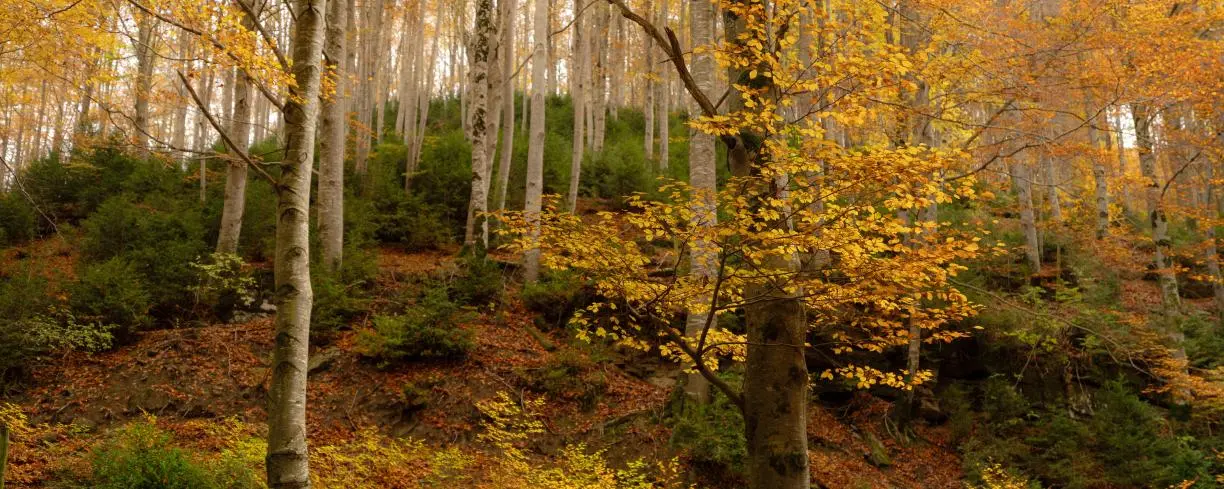

When autumn arrives, deciduous trees begin to transform: their leaves change color and eventually fall. The green landscape gradually turns to shades of yellow, orange, and brown as the leaves fall, forming carpets of leaf litter on the forest floor.
This natural process indicates that the landscape is entering a new phase, marked by lower temperatures and shorter days. But what is really happening inside the trees? And why do only deciduous trees undergo these changes?
Why do tree leaves change color in autumn?
Why do tree leaves change color in autumn?
Deciduous trees are those that lose their leaves during a certain time of year. Like all plants, they depend on light to perform photosynthesis, a process that generates energy and allows them to grow. So why do they fall when autumn arrives?
At this time of year, temperatures begin to drop, nights are cold, and the days have fewer hours of sunlight—more technically, we would say the photoperiod is shorter . Deciduous tree species detect that the days are getting shorter and activate a protective and energy-saving mechanism to survive this period: they shed their leaves .
But the falling of leaves from trees doesn't happen overnight: it's a preparation process that lasts weeks and begins with the change in leaf color . The first step deciduous trees take is to make the most of the nutrients in their leaves, such as nitrogen, phosphorus, and potassium. To do this, with the help of plant hormones—yes, plants have hormones too!—they redistribute these nutrients to other parts of the tree, like the branches and trunk, so they can be reused the following spring.
Once nutrients are secured elsewhere in the tree, they begin an energy-saving phase . Deciduous trees gradually stop photosynthesizing: they cease producing chlorophyll and eliminate what was already in their leaves .
Chlorophyll is the natural pigment that gives plants their green color and is also the most important molecule for photosynthesis. As chlorophyll disappears, it reveals other pigments , such as carotenes—responsible for the orange color—and anthocyanins—which give the red color.

Pallars Sobirà forests. Author: Paco Lloret
Why do leaves fall?
Why do leaves fall?
The change in leaf color is gradual until the tree is ready to shed them. In the final stage of color change, the leaves lose all active pigments, leaving only tannins, which are the result of cell breakdown and give the leaves their brown color. Three plant hormones work together to trigger leaf fall: auxin, ethylene, and abscisic acid (ABA) .
The leaves are attached to the branches by their lower, tail-like part, called the petiole . In this area, there is a small tissue called the abscission zone , where hard cells accumulate and are protected by auxin. Auxin is responsible for keeping the leaf attached to the branch while inhibiting the production of ethylene and abscisic acid.
The plant detects that it is getting colder and there are fewer hours of sunlight and synthesizes less auxin. When this happens, the plant begins to produce ethylene and abscisic acid, the hormones that will cause the leaf to detach from the branch and fall .
In some cases, leaf drop can also be a sign of old age . Trees don't grow indefinitely, but they also don't have a set age at which they die. It all depends on the species, their location, and whether they have suffered any disturbance or disease. When a tree gets old, it shows signs of advanced senescence : this means that its tissues are fatigued, cells are dying, and this can cause leaves, branches, or even the trunk to collapse. All of this indicates that the tree is entering its final stage.
What are the typical pigments of autumn and what is their function?
What are the typical pigments of autumn and what is their function?
During autumn, the leaves display a wide variety of colors: when chlorophyll (the green pigment) is destroyed, other pigments that are always found inside the cells of the leaves and participate in the process of photosynthesis are revealed.
Each pigment has a specific function that helps the plant adapt to the changes in light and temperature during this season. For example, some help absorb other wavelengths of light or act as protective pigments.
The main pigments typical of autumn are carotenoids, xanthophylls and anthocyanins.
- Carotenoids and flavonoids : These help capture different wavelengths of light and act as antioxidants, protecting the plant from ultraviolet radiation during photosynthesis. They are divided into two main categories: carotenes and xanthophylls. Beta-carotene, one of the most common carotenes, absorbs green and blue light and reflects red and yellow light, giving it its characteristic orange color. This pigment can be found in carrots and tomatoes.
- Xanthophylls : These are a subtype of carotenoids responsible for the yellow hues of autumn. Like other carotenoids, they are present in leaves year-round, but become visible when chlorophyll breaks down. Lutein, one of the main xanthophylls, is the pigment that gives egg whites and bananas their yellow color.
- Anthocyanins : These provide red and purple hues. Unlike carotenoids, anthocyanins are not always present in leaves; they are synthesized as chlorophyll disappears. Although their function is not entirely clear, they are believed to protect leaves from excessive light and ultraviolet radiation.
Autumn or drought: how to tell the difference?
Autumn or drought: how to tell the difference?
Sometimes, the brown hues of the landscape can be mistaken for drought . The key is to look at the pattern of the color change , as it varies in each case. This is explained by the team behind the CREAF citizen science project, Forest Alert , which aims to analyze the current health of Catalonia's forests. For example, insect infestations usually cause localized patches of affected trees, while drought leads to a more uniform drying of some trees, and the color change can be more widespread.
Another difference is the intensity or brightness of the color : autumn colors are vibrant, while those of drought are more muted. Finally, you can distinguish whether browning is due to drought or the arrival of autumn by whether the color change occurs more rapidly or gradually . Autumn coloration in deciduous trees is a programmed process. In contrast, drought causes the leaves to change color more abruptly . In this case, since the change is so sudden, the tree doesn't have time to redistribute nutrients from the leaves to other parts of the tree, and this can further compromise the tree's health.
To learn how to differentiate these symptoms, here you can learn how to detect drought alerts and consult its map .

Roureda affected by drought in the Farga de Bebié (between Osona and Ripollès) this 2022. Authorship: anonymous user of AlertaForestal.
What happens inside trees when the cold arrives?
What happens inside trees when the cold arrives?
Unlike animals, trees cannot move or migrate when environmental conditions change or become adverse, such as during cold weather or drought. Therefore, they have developed strategies to survive in different situations.
Trees are generally classified into two types: deciduous and evergreen. As we can see in Mediterranean forests, deciduous trees , such as oaks, fruit trees, chestnut trees, and beeches, lose their leaves when it gets colder and there is less light because they cannot properly absorb nutrients from the soil or water. Therefore, when the cold weather arrives, they enter a period of dormancy until warmer weather returns.
During this hibernation process, the trunk stops growing and stores energy to reactivate in spring, when the leaves sprout again. However, the roots of deciduous trees never rest and continue to grow , according to a recent study by CREAF.
In contrast, evergreen trees , such as holm oaks, olive trees, pines , and firs, are species that can withstand extreme conditions like cold. They retain their green leaves year-round, but renew them very slowly and don't shed them until new ones have grown in.
TAMBÉ ET POT INTERESSAR
TAMBÉ ET POT INTERESSAR

Claus per a identificar les diferents espècies de pins, infografia disponible!
Claus per a identificar les diferents espècies de pins, infografia disponible!
Deciduous tree species of Mediterranean forests
Deciduous tree species of Mediterranean forests
Autumn allows us to visualize the diversity of forest species in a spectrum of colors. This is particularly evident in Mediterranean forests, where deciduous and evergreen species coexist. However, evergreen species predominate, a fact easily understood in light of the climate.
In the Mediterranean region, the water available to trees changes considerably throughout the different seasons . Therefore, evergreen trees are best able to withstand periods of drought and, moreover, do not have to expend as much energy rebuilding their foliage in spring.

Autumn landscape of a riverside forest in Pallars Sobirà. Image: Galdric Mossoll
And why are deciduous trees always found near rivers? In these areas, as well as near aquifers, streams, and dry riverbeds, there is always more water and more nutrients. It's a comfortable situation for the trees, making it easier for them to produce new leaves when spring arrives . That's why they choose to shed their leaves and regenerate them.
Deciduous species that stand out for their color changes are:
- the beech ( Fagus sylvatica )
- the chestnut tree ( Castanea sativa )
- various oaks such as Quercus robur, Q. petraea, Q. pyrenaica or Q. humilis
- the birch ( Betula spp. )
- the ash tree ( Fraxinus excelsior )
In riverside areas, we can also see deciduous trees such as:
- the white poplar ( Populus alba )
- the black poplar ( Populus nigra )
- the elm ( Ulmus minor )
- the willow ( Salix spp. )
- the alder ( Alnus glutinosa )
TAMBÉ ET POT INTERESSAR
TAMBÉ ET POT INTERESSAR

Com identificar les espècies de roures peninsulars?
Com identificar les espècies de roures peninsulars?
Autumn, a great time to see mixed forest landscapes
Autumn, a great time to see mixed forest landscapes
Autumn is an ideal time to observe mixed forests, formed by a combination of deciduous and evergreen species. This diversity of species becomes especially visible with the changing colors of the leaves, creating spectacular landscapes and helping us to easily identify mixed forests .
Mixed forests have great ecological value , as their variety of tree species fosters a greater diversity of animals and other organisms that find their habitat there. Furthermore, the more diverse the forest's composition, the greater its capacity to respond and recover after disturbances or impacts , such as drought, fire, strong winds, pests, or diseases. This is possible because each species has its own coping mechanisms, and they complement each other. This ability to maintain the forest's main functions despite disturbances is called ecological resilience .
Furthermore, the diversity of mixed forests helps stabilize forest production , improve soil quality, and promote ecological connectivity —that is, the connection between different natural areas. This facilitates the movement of species such as insects and birds across the territory.
Ecological and adaptive benefits of losing leaves
Ecological and adaptive benefits of losing leaves
For deciduous trees, losing their leaves can represent a significant energy expenditure because they must regenerate them after winter. Conversely, shedding their leaves is an evolutionary adaptation that allows them to withstand periods of the year with harsher environmental conditions.
What are the advantages of losing leaves in autumn?
What are the advantages of losing leaves in autumn?
- Protecting against the cold: leaves can be vulnerable to frost and harsh winter conditions. By shedding them, the tree avoids this damage.
- Energy efficiency: Maintaining leaves during winter requires a significant investment of energy to sustain photosynthesis under adverse conditions. However, the tree enters a dormant state and conserves resources.
- Nutrient renewal and recycling: fallen leaves decompose and enrich the soil with nutrients, which the tree can reuse in spring.

Peno oak ( Quercus robur ) leaves in the flooded Roureda of the Tordera, in the Maresme. Image: Galdric Mossoll
On the other hand, the forest also benefits from trees that lose their leaves in autumn. When the leaves of deciduous trees fall to the ground, they mix with other organic matter and accumulate. This is called leaf litter, which is made up of organic matter, plant debris such as leaves, branches, twigs, pollen, fungi, and animal remains, such as feces and invertebrate remains.
Benefits that deciduous leaves bring to forests:
Benefits that deciduous leaves bring to forests:
- Leaf litter nourishes detritivores, or decomposers, that live in the soil, such as earthworms. They break down organic matter and transform it into humus, and in turn, they are prey for many insects, birds, reptiles, and small mammals.
- It helps to form the organic layers of the soil
- It acts as a habitat and refuge for many insects and other invertebrates
- It promotes water absorption and moisture retention in the soil.
- It protects the soil from erosion, desiccation, ultraviolet solar rays, light, and thermal shock.
TAMBÉ ET POT INTERESSAR
TAMBÉ ET POT INTERESSAR

Is autumn changing because of climate change?
Is autumn changing because of climate change?
Meteorological autumn begins on September 1st, but how do we know that autumn officially begins in nature? The main indicator is the changing colors of the forest, which we can observe in the landscape . We know autumn is coming because the trees change color, the landscapes turn yellow, orange, and brown, and the weather also changes.
However, in recent years autumn has not arrived as expected. Global warming is leaving its mark, and anomalous temperatures can shorten the climatic autumn. For example, in 2021, CREAF detected that autumn arrived considerably later than the previous year because September was warmer than normal, and even October exceeded the usual average.
These climate changes can confuse species that are normally synchronized with the weather of each season, and consequently, their biological cycles or phenology can be altered . In fact, several studies and projects by CREAF demonstrate that these temperature changes are visible both in spring, when some trees bud and flower earlier than usual, and in autumn, when some plants have shed their leaves later than normal, and in some cases have even flowered again in autumn .
In this respect, scientific monitoring is essential to determine whether autumn is arriving early or late. On the one hand, satellite imagery can provide key information about changes in landscape colors. For example, images showing tree colors can be obtained from the Copernicus portal, the European Union's Earth observation program, which collaborates with CREAF . In this case, by observing deciduous forests, such as those surrounding Turó del Home in Montseny, on two different dates, we can see how their colors change.

Satellite image of the Cerro del Hombre area (Montseny), dated September 3, 2025. Source: Copernicus

Satellite image of the Cerro del Hombre area (Montseny), dated October 10, 2025. Source: Copernicus
Observe the trees in autumn with citizen science
Observe the trees in autumn with citizen science
To detect changes in tree phenology, citizen participation can also be key , especially in very localized areas where satellites don't have high resolution. That's why CREAF is studying the effects of climate change on nature through the citizen science project RitmeNatura .
This is a participatory observatory that gathers evidence of phenological changes in more than 3,000 animal and plant species . While accepting occasional observations, the project promotes the adoption of common deciduous plants , which are easy to identify, such as ash groves or fruit trees, and have clear phenological phases.
Thanks to observations provided by citizens, it has been shown that climate change is making autumn increasingly anomalous, and it has even been observed that some plant species have a second flowering in autumn, in addition to spring.
Specifically, between July 2023 and June 2024, the public helped identify 214 plant species that had flowered out of season . The cause of this seasonal disruption was anomalous temperatures and an altered rainfall pattern.
The consequences of these effects can have a ripple effect, impacting other species within the ecosystem. If you're interested in tracking the phenological rhythm of autumn and contributing to the study of climate change effects, find out how to participate in the project here .
WITH THE COLLABORATION OF:
WITH THE COLLABORATION OF: