The pine processionary moth: 10 predators and parasitoids that help control it

Have you ever noticed the white nests that can be seen in winter in many of pine forests of the Mediterranean area? They are not spider webs and there is no spider hiding inside them. Instead, they shelter the caterpillar of the pine processionary moth ( Thaumetopoea pityocampa ), a species native to the region .
But, does this stinging insect, so common in pine forests, have predators? Are there any animals capable of eating it? The answer is yes, however, to understand who they are, we must first look at the processionary moth's life cycle. Depending on the time of the year, it can be found as an egg, as a caterpillar, as a chrysalis or as a moth.
The life cycle of the processionary moth
The life cycle of the processionary moth
Between July and September, adult moths emerge from the ground after a period of diapause - a pause in their development that allows them to survive unfavorable conditions - they fly to the tops of pine trees, where they lay their eggs. Later, when the eggs hatch, the caterpillars begin feedingon pine needles.
Later, s temperatures drop, they gather together to build the characteristic white nests, which help them survive the winter cold. At the end of larval development they descend from the trees, one after the other in procession (hence their name) to burrow into the ground to pupate.
YOU MAY ALSO BE INTERESTED IN
YOU MAY ALSO BE INTERESTED IN

Who eats the pine processionary moth? Its natural enemies in Catalonia
Who eats the pine processionary moth? Its natural enemies in Catalonia
The pine processionary moth is part of the forest ecosystem and plays a role in their complex food webs. On the one hand, it is part of the usual diet of many animals. In the forests of Catalonia there are several animals that eat it, both when it is in the caterpillar and moth stages. On the other hand, there are insects with parasitic behavior that need the processionary moth caterpillar to lay their eggs and thus complete their life cycle.
Birds: natural controllers for the pine processionary moth
Birds: natural controllers for the pine processionary moth
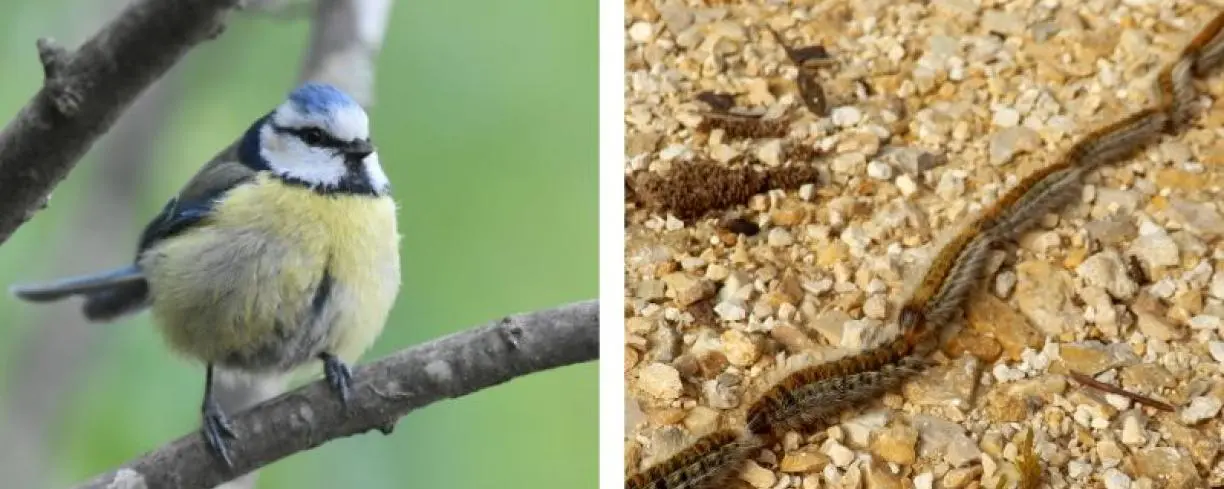
The great tit ( Parus major ) is one of the birds that feeds on the processionary moth. Specifically, it does so on processionary caterpillars, particularly before they develop their characteristic stinging hairs. In addition, it also has the ability to open the processionary nest bags with its beak, and this allows other birds, such as the blue tit (Cyanistes caeruleus) , to access the caterpillars and eat them. Another species , the coal tit (Periparus ater) also feeds on small invertebrates, including the processionary moth.
There are other birds that feed not only on caterpillars in pine trees but also on caterpillars and pupae buried in the soil. This is the case of the hoopoe (Upupa epops) which uses its long curved beak to dig in search of pupae. To eat the caterpillars, it first grabs them and repeatedly strikes them to remove their stinging hairs. But it is not the only bird capable of eating the processionary once it has been buried: the blackbird (Turdus merula) can also dig up pupae and caterpillars.
There are even birds that feed on the moth stage of the processionary moth. The european nightjar (Caprimulgus europaeus) catches them in flight at night.

Ppuput (Upupa epops). Photo: Marta Josa
Wasps and flies: parasitoids of the processionary moth
Wasps and flies: parasitoids of the processionary moth
So far we have reviewed the birds of the Mediterranean forests that feed on the processionary caterpillar, but there are other animals that also prey on them and even parasitize them. One of the most surprising examples is that of some wasps such as Meteorus versicolor and flies such as Phryxe caudata that lay eggs on the caterpillars. When they emerge from the egg, the larvae enter the body of the caterpillar and feed on it from the inside, eventually killing it. In fact, they are insects that are often used in biological pest control.
But the processionary moth is not free from predators in any of its life cycle phases, because when it is in the egg phase there are parasitoid wasps ( mainly from the genera Ooencyrtus and Barycapus ) that deposit their eggs inside the processionary moth's eggs.
Mammals and bats
Mammals and bats
In addition to the birds and insects that parasitize the processionary moth, there are also some forest mammals that eat it. The garden dormouse (Eliomys quercinus), for example, digs up the caterpillars and pupae to eat them. For insectivorous bats , moths are a very tasty dish: they hunt them in flight at night and eat them!

Dwarf Pipistrel ( Pipistrellus pygmaeus). Photo: Oriol Massana and Adrià López Baucells (www.ratpenats.org)
YOU MAY ALSO BE INTERESTED IN
YOU MAY ALSO BE INTERESTED IN

Participate to observe the pine processionary and better understand the forests!
Participate to observe the pine processionary and better understand the forests!
As we have seen, the processionary moth has several natural enemies that are part of the balance of forest ecosystems. However, their abundance and impacts can vary greatly from one year to the next and from one place to another, depending on environmental conditions.
Normally pine trees have the ability to recover from defoliation. However, climate warming may create more favorable conditions for the processionary moth, increasing its abundance. If this situation persists over time, it can weaken trees and make them more vulnerable to other stress factors such as pests or drought.
Therefore, monitoring its impacts it entails is key to understanding how our forests evolve, especially in a context of climate change.
If when you go to the forest you see processionary nests or pine trees affected by defoliation , you can take a horizontal photograph and upload it to the Alerta Forestal web-app , a CREAF citizen science project that collects observations on the health of forests.
With this data, the research team can analyze how forests respond to different impacts and improve knowledge about forest health.
WITH THE COLLABORATION OF:
WITH THE COLLABORATION OF:
Josep Ma Riba Flich
Entomologist expert in forest pests and collaborator of Alerta Forestal.