23/07/2025 News

Carbon and time inspire the first Jaume Terradas artistic residency

Communication Manager

Anna Ramon Revilla

I hold a degree in Biology (2005) by the Universitat Autònoma de Barcelona, and a Master in Scientific and Environmental Communication (2007) by the Universitat Pompeu Fabra. Since 2011 I

There are ideas that can only be born at the limits. In the areas of contact between ecosystems, disciplines or perspectives. It is there that new questions flourish, where creativity can act as a bridge between seemingly distant worlds. With this spirit, the Jaume Terradas artistic residency at CREAF was born: an organic and collective proposal arising from ECOTONS , the center's art and science group.

This residency does not start from an open call, but proposes a new model of tailor-made collaboration. First, research groups interested in working with artists are identified. Then, artists who can genuinely connect with the themes and practices of these scientific teams are carefully sought. If a research explores the sounds of the landscape, artists who work with sound are proposed. If it deals with complex data, artists are sought who work on how to convert them into other languages. The goal is not to make art “about” science, but art “with” science: with dialogue, listening and co-creation.

A curated and radically collaborative residency

To accompany this process, ECOTONS has invited Paula Bruna as curator of the residency. An environmentalist and doctor in Fine Arts, Bruna acts as a bridge between scientific and artistic languages, facilitating a dialogue that often moves between concepts as abstract as carbon, gases or time.

Although seven CREAF research groups showed interest in the first internal call, and promising contacts were generated with several artists, the residency will finally focus this year on a single pilot project, with an intense and transformative collaboration between the group of Estefanía Muñoz and Filipe Andrade , and the artistic collective LaCuartaPiel , which has chosen Ximo Berenguer , Ana Moure , Inés Miño and Carlos Pastor to do so as part of the collective.

paula_bruna_150

In this first project, the dialogue has already begun to generate very rich exchanges: from imagining how to encapsulate air in a jewel to translating scientific data into sensory experiences. The goal is not to simplify science, but to open it to new layers of meaning. However, this approach also requires an extra effort on the part of the scientific staff, who have shown great generosity and commitment by putting in time, energy and sensitivity

The residency was born with the desire to create a deep and reciprocal relationship between artists and scientists, beyond a one-off collaboration. For this reason, a tailor-made model has been chosen, based on the needs and rhythms of research.

In this first project, the dialogue has already begun to generate very rich exchanges: from imagining how to encapsulate air in a jewel to translating scientific data into sensory experiences. The goal is not to simplify science, but to open it to new layers of meaning. However, this approach also requires an extra effort on the part of the scientific staff, who have shown great generosity and commitment by putting in time, energy and sensitivity ”, comments Paula Bruna.

Dialogues between codes, carbon jewels and air in bottles

Estefanía and Filipe work on topics as inaccessible to the naked eye as gas exchange and the carbon cycle, and have generously opened their data, figures and methodologies to artists. LaCuartaPiel, specialized in interactive art installations, work from a poetic and critical perspective on the invisible, ephemeral or corporeal. Their pieces seek to provoke sensory and reflective experiences in the audience, and combine disciplines such as jewelry, performance, architecture, biology, scientific materiality and visual arts.

In the first meetings, the researchers have shared codes, figures, data from flow towers, and even field anecdotes that reveal the complexity of explaining the intangible: "Once, returning from collecting gas samples in the field, at a police checkpoint in Colombia, we didn't know how to explain that we were carrying bottles full of air in the car." This desire to explain without simplifying, to share knowledge in all its complexity, has been fundamental so that the artists could begin to create from interpretative freedom.

Estefania_munoz_150

The artists ask us questions that we had not considered, not so much to find scientific answers, but to explore meanings. They challenge us about the beauty of what we measure, about the emotional dimension of what is invisible. And this also transforms the way we communicate and share our work.

We are very attracted to the possibility of looking at our research with new eyes ,” explains Estefanía Muñoz, “ The artists ask us questions that we had not considered, not so much to find scientific answers, but to explore meanings. They challenge us about the beauty of what we measure, about the emotional dimension of what is invisible. And this also transforms the way we communicate and share our work .”

The project is structured into a research phase (July), a production phase (autumn) and a final presentation before the end of the year. The form of the final result is yet to be determined, but it is expected that the artwork will not only dialogue with science, but also challenge the public and invite them to ask questions.

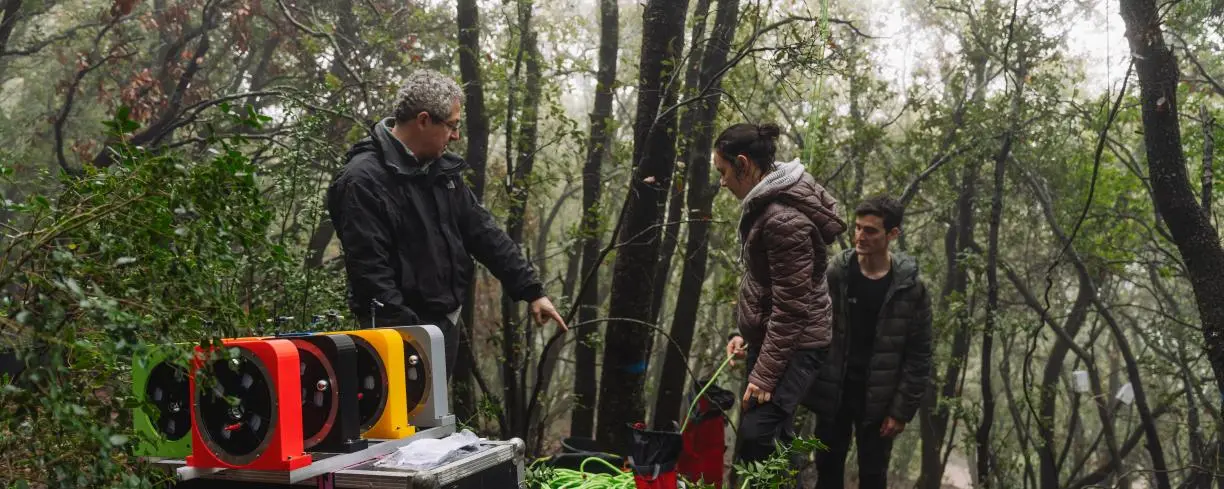
trabajo_campo_gmossoll

Fieldwork by researchers. Image: Galdric Mossoll

The Jaume Terradas artistic residency is, at the same time, an institutional commitment to growing CREAF's vision towards art and a demonstration of the commitment of the researchers who have opened the doors of their laboratories, data and ideas to other ways of expressing and understanding the world.