At BioAgora, we work to foster dialogue and collaboration between science and policy at the European level, with the aim of improving biodiversity-related decision-making.


Achieving the goals of halting the decline of biodiversity and improving its status, such as the well-known Kunmin-Montreal Global Biodiversity Framework, signed in 2022 by 196 countries, involves obtaining data that allows us to answer some questions such as: How can we conserve 30% of the terrestrial and marine area? Where and how can we restore damaged habitats? For which species do we have data to know if their situation is improving compared to previous years?
To do this, data is needed, often obtained through species monitoring programs such as the CBMS for butterflies or Ratpenats.cat, which provide key information on the state of populations and habitats over time. In theory, the more information available, the more accurate decisions should be. However, it is increasingly clear that the challenge is not just to generate data, but to know how to interpret, integrate and transform it into useful knowledge to inform public policies.
In this context, the European project BioAgora was born to strengthen the connection between science and public policies on biodiversity . The project is developing the future Science Service for Biodiversity at a European scale, with the aim of improving the design and implementation of policies related to biodiversity.
At CREAF, this task is led by the Ecoland research team, coordinated by Lluís Brotons, a CSIC researcher at CREAF. The team has been working on the BioAgora project for 3 years with the aim of creating and mobilising a network of experts to answer specific questions that the European Commission has on biodiversity. This network will function as an online platform where experts will exchange knowledge from research to answer questions that the Commission has in order to improve policies, for example in improving the reporting of the Habitats and Birds Directives.
One of the people involved in in this knowledge mobilization is Maria Blasi, a CREAF researcher, who is part of the BioAgora team. She contributed in in the creation and coordination of this European network of experts in the field of biodiversity monitoring ( Monitoring Expert Knowledge Network (KEN) ) which supports the European Commission in the field of biodiversity.

Maria Blasi presenting Monitoring KEN at the Living Data25 conference
At BioAgora, we work to foster dialogue and collaboration between science and policy at the European level, with the aim of improving biodiversity-related decision-making.
Maria Blasi – Postdoc of the Ecoland group and the BioAgora project.
However, if having all the information is already a great challenge that mobilizes hundreds or thousands of volunteers around the world, and a quantity of scientific research that is not digestible for decision-makers, there are still a series of problems that make it difficult to inform good policies:
The forgotten species
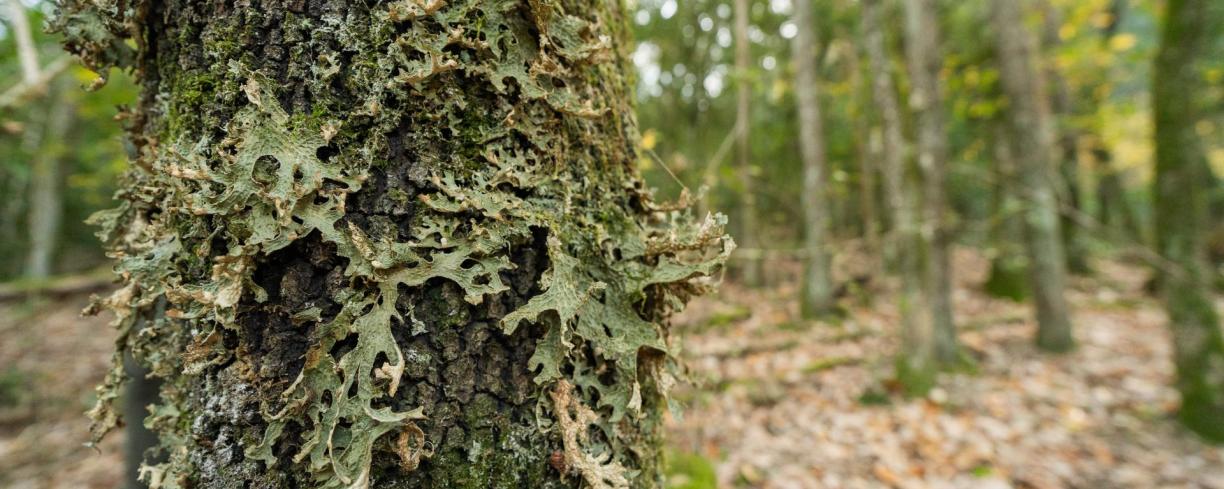
There are groups of species, such as birds or mammals, or even habitats, that are much more studied, either due to historical precedent, legislation, ease of sampling or because there are more experts studying them. On the other hand, there are organisms about which we still lack a lot of information. These are species that are either not so charismatic, are found in areas that are difficult to access or in places where resources for monitoring are limited. We are talking, for example, about lichens, some insects, zooplankton and crop pests.

Lichens are one of the least monitored groups. Photo: Galdric Mossoll
When monitoring methods differ widely
When monitoring is not carried out in a standardized manner, it happens that, even though the same species or habitats are monitored, the methods used can vary greatly depending on the project, the country or even the team that carries them out: differences in sampling frequency, field protocols, tools used or the way in which data is analyzed.
This lack of standardization makes it very difficult to compare data over time or between territories , and limits the possibility of integrating them on larger scales, such as the European one. Consequently, data that are individually very valuable lose some of their potential when they are used for global monitoring or to inform public policies.
Hidden data
Finally, it is also very difficult to process huge amounts of data. For example, in bioacoustic monitoring, where recorders can be on all night recording sounds, the task of analyzing and processing all this information can take a lot of time. The same goes for camera traps, which are usually left for longer or shorter periods in the field and generate hundreds or thousands of images that then have to be looked at one by one to process them. Even with DNA samples, where the particularities of laboratory analysis can make the process quite slow.
In addition, there is still a lot of data that is scattered among different organizations and others that are accumulated or hidden in museum collections that are not registered in databases.
Sharing and coordinating efforts
In this context of limitations with biodiversity data, spaces for exchange and coordination at a European level are key to moving towards more integrated and useful biodiversity monitoring for decision-making.
One example is the Biodiversity Monitoring Week (BioMonWeek 2026) , which will take place in Montpellier in May 2026 and is being organized by BioAgora together with other partners. The meeting will bring together researchers, administrations and other key actors to share methodologies, data and experiences in biodiversity monitoring, and thus contribute to overcoming some of the challenges described in this article.
More information: https://www.biomonweek.eu/