


This change does not have to be entirely bad, since this type of open landscapes favor a mosaic structure, which is at the same time more resilient to fires and favors biodiversity.

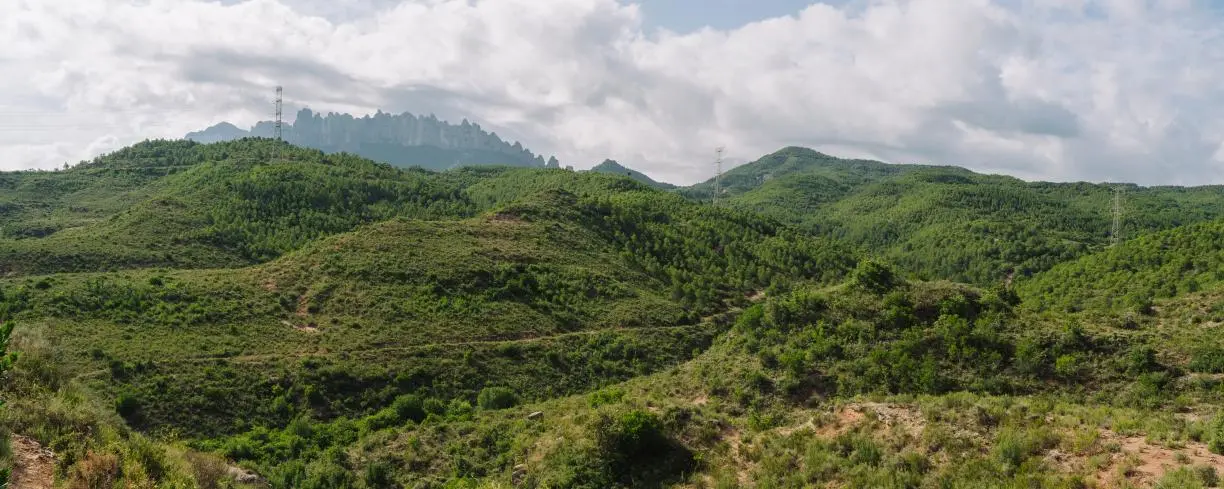
On July 26, 2015, the counties of Anoia and Bages suffered a fire that burned 1,235 ha. Now, a decade later, the landscape is not as expected. What should be a fairly dense white pine forest is an open landscape, dominated by scrub and some pines and holm oaks. Why is this forest regenerating in a different way?
Part of this burned area was young pine forests, also known as saplings, which had regenerated after a fire in August 1986. The fire burned 15,882.30 hectares in the forests around Montserrat, Bages and Berguedà and is remembered as one of the most serious fires in central Catalonia. Those forests recovered quickly: the pine nuts that germinated after the fire grew massively to the point of forming large “carpets” of pine trees, almost without leaving space between each other, a landscape structure that is not the most ideal either and that, in fact, has already been studied how to manage . Now, a decade after the Òdena fire, the landscape has not followed the same pattern of recovery .
YOU MAY ALSO BE INTERESTED IN
A “different” regeneration conditioned by drought
In the eyes of the scientific community, the Òdena fire is considered one of the great fires of the 21st century in pine forests in Catalonia , marked by a regeneration pattern different from the rest of historical fires. "It is a new model of post-fire response, where drought becomes a determining factor in the capacity of Mediterranean forests to recover", explains Josep Maria Espelta , researcher at CREAF.
CREAF data indicated that 70% of the land that burned was Scots pine forests that had between 250,000 and 400,000 pine nuts per hectare for regeneration after the fire . However, 2016, a year after the fire, was particularly hot and dry in inland Catalonia, the second warmest since 1955, only surpassed by 2015. Specifically in Anoia, during the spring it rained 30% of what it would be on average. This lack of water slowed down the regrowth of trees that had survived the fire , such as oaks and holm oaks, but also slowed down the germination and growth of pine nuts that were dispersed after the fire.
Espelta recalls that “we were surprised to see that the forest was not regenerating as it had done 30 years ago; if in a normal situation we would have expected to see up to 30 thousand pine trees per hectare, this time it barely reached 1,000 pine trees per hectare”.

Currently, the burned area of Òdena is an open space dominated by shrubs and bushes. Author: Galdric Mossoll

Another current image of the burned area of Òdena. Author: Galdric Mossoll
More open landscapes are an opportunity for fire prevention
The drought has given rise to a new landscape structure with less pine density, but Espelta points out that “this change does not have to be entirely bad, since this type of open landscapes favor a mosaic landscape, which is at the same time more resilient to fires and favors biodiversity.” In fact, there are many species that benefit from the post-fire landscape, such as the Bonelli's eagle or pollinating insects.
Following the 2015 fire, several projects were launched to better manage these new scenarios. One of the most prominent was the Life Montserrat project . This project took advantage of the transformation of the landscape to introduce extensive livestock farming , with the aim of maintaining open spaces, reducing the risk of future fires and promoting biodiversity. Thus, post-fire management focused not only on forest regeneration, but also on the resilience of the territory and its sustainable use.
This change does not have to be entirely bad, since this type of open landscapes favor a mosaic structure, which is at the same time more resilient to fires and favors biodiversity.
Land management must be considered taking into account the effects of disturbances.
With climate change, disturbances such as drought will become more frequent and intense. In this case, it has not only limited the extent and density of the pine forests that recovered from the Òdena fire, but in other parts of Catalonia the lack of water caused the death of many trees .

The mosaic landscape includes forested land with trees, scrubland and agricultural land. Author: Galdric Mossoll
European-scale models predict that landscapes will become increasingly open and forest masses will be less connected to each other. For this reason, the CREAF researcher recalls that " it is important to manage in line with this new reality and try to recover or mimic the traditional agroforestry mosaic , one of the most valuable landscapes both at a cultural level and for conserving Mediterranean biodiversity and resilience to fires."
YOU MAY ALSO BE INTERESTED IN