Urban gardens, the "Swiss army knife" of sustainable cities


People need to find alternative ways of consuming and living, and have more and better access to green spaces. This is the lesson learned after a global pandemic linked to globalization and the destruction of nature , which is added to the current climate crisis. An interesting option for cities to respond to this is urban gardens, multifunctional spaces that provide a more sustainable supply while opening up a whole range of links with the environment, community and learning.
The current supply system is inefficient in the face of crises and has environmental, social and economic implications, as well as fostering inequality.
Today, our consumption is based on products imported from other countries that produce or manufacture at a lower cost. And this can sometimes shake the supply system itself, as we have seen with the pandemic caused by the coronavirus and the closure of the borders of the Spanish state with other European states. In fact, it is not only inefficient in the face of these crisis situations, but also has environmental, social and economic implications related to the energy expenditure and emissions involved in its transport, for example, or with the control of markets by a few oligopolies, which puts the continuity of local agriculture or livestock farming and its protective role of the territory at risk. Without forgetting that, in reality, supply is still not assured throughout the planet, since there are strong inequalities.
Urban gardens are green spaces that serve many purposes: they are multifunctional, like Swiss army knives.
To combat this scenario, the concept of food sovereignty is gaining strength, according to which each town has the right to decide on what it consumes and in which the creation of local gardens is highly valued. These gardens are called urban when they are developed in cities or their outskirts, whether on municipal estates, in schools or in a small 40 m2 apartment in Barcelona's Eixample. Unfortunately, and being realistic, in large cities the supply of fruit and vegetables only with urban gardens would not be sufficient for the entire population, but these spaces provide many other services. According to experts, they are multifunctional green spaces or, what would be the same, that serve many things; the Swiss army knives of sustainable cities.
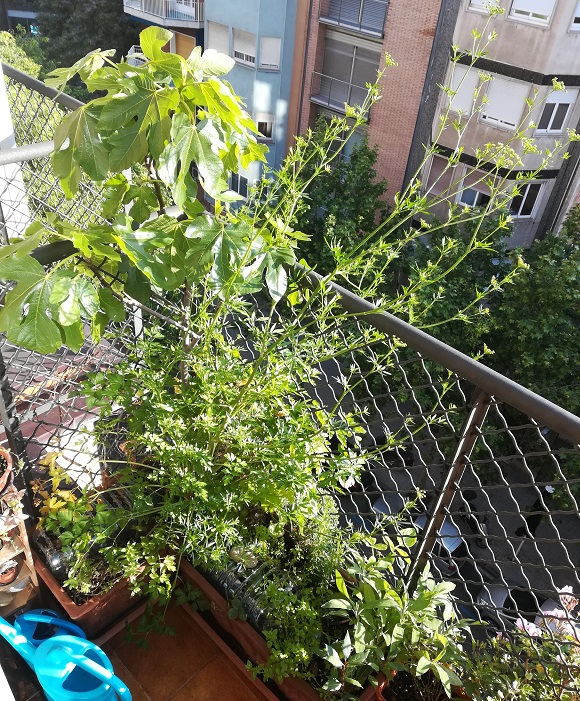
“ Urban gardens promote the biodiversity of cities because they connect different parks and gardens, are also included in social cohesion projects and improve the well-being of the people who grow them and those who enjoy them when they walk around the city,” explains Corina Basnou , a researcher at CREAF. She adds that “we must consider that this practice is also related to public health, because by producing food at home we can know what we eat, its quality and how it was obtained.”
"People need greenery and we have to go and look for it outside the cities. If we had it nearby, we would avoid a lot of unnecessary and polluting car trips."
Although it is likely that urban gardens will not directly improve the quality of the city's air —as is the case with parks and gardens, which are larger and have a greater surface area of leaves that carry out photosynthesis and "clean" the air— they do have the potential to improve it indirectly. Anna Àvila , also a researcher at CREAF, mentions this: " people need greenery many times and we have to go and find it outside the city. If we had it closer, we would avoid many unnecessary and polluting car trips."
Coronavirus confinement: starting point for CREAF's experiments in urban gardens
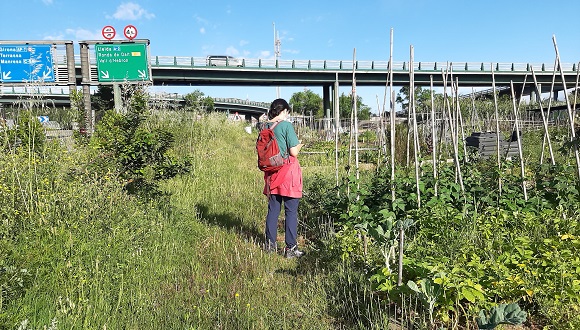
Through the HORTS4U project , led by CREAF in collaboration with Barcelona Regional and Barcelona City Council, researchers Corina Basnou and Anna Àvila are in charge of measuring heavy metal pollution (lead, copper, arsenic and mercury, among others) in Barcelona's vegetable gardens, the atmospheric pollution that reaches and is deposited on the plants in our vegetable gardens. Specifically, they have chosen six well-differentiated points in the city to measure it, such as the Trinitat junction —with a lot of traffic— and Can Pujades in Collserola —as a little-frequented area.
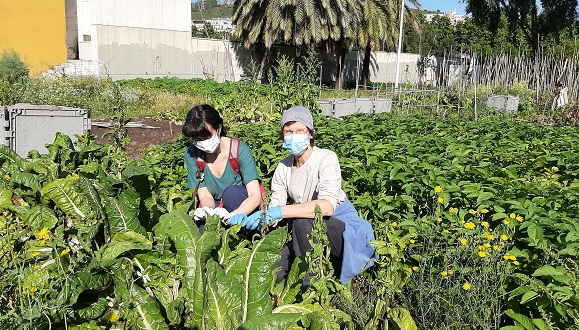
"The experiment was supposed to start in March and the lockdown had just arrived. In this situation, pollution dropped drastically throughout the city and we thought it was a good opportunity to sample the orchards at an exceptionally clean time. We are waiting for the analytical results, but it is clear that it will be a good point of reference," explains Anna Ávila .
Educate in green
Another implication of urban gardens is learning : which plants produce each fruit, what local vegetables taste like, what we can eat depending on the season. Tomatoes don't come from the supermarket and they aren't there all year round! Schools and universities are increasingly daring to create gardens in their courtyards and pass this knowledge on to students.
Urban gardens also allow you to get to know the plant world and the food it offers better: tomatoes don't come from the supermarket or grow all year round!
“ At the Faculty of Education at the UAB we have jumped into the pool and decided to follow permaculture to design our garden, which consists of copying the dynamics and aesthetics of natural ecosystems,” says Sandra Saura , a CREAF researcher and professor at this university. “The uses we are making are many, from outdoor teaching for teacher trainees, to student research for master's or final degree projects. Also to weave a community between the people who participate in them”. In fact, these projects are already a reality and the CREAF biologist presents 'Let's look at the world', a subject that is taught to students of the Education degree and that includes the project 'We are what we eat' on food in educational centers, the urban biodiversity of gardens and other related concepts.

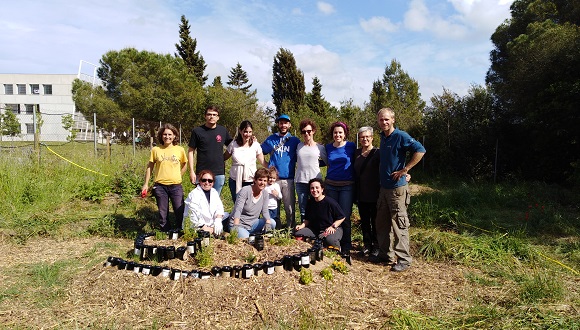
Àngela Ribas , also a researcher at the center and professor at the UAB, relates it to the inclusive Magnet program : "we have transferred the benefits of urban gardens to the Peramàs school in Mataró, which has an alliance with CREAF, and they have valued creating one in the yard. Thanks to this, they have learned a lot about the importance of healthy soil, how to make compost and the responsibility it implies." Another option to learn more about the plant world when you can't maintain a garden is vertical gardens or sprouts in pots.
So, urban gardens are one of the many ways that exist to immerse ourselves in nature, in more sustainable agriculture and in how to face the climate crisis that is upon us. It is clear that the recent confinement has opened our eyes and has made it very explicit that a change of culture is needed, that we need more green spaces in our cities and that now is the time to plant the first seed!