

We want to study how trees manage these water reserves to predict how Mediterranean forests will respond to climate change. Furthermore, this knowledge can be incorporated into forest mortality risk models.


Climate change is testing the ability of forests to survive. Droughts will become more frequent and intense, directly affecting vegetation growth, with a greater risk of fires and vulnerability to diseases and pests. However, trees will suffer even more from lack of water.
In their internal ducts they transport water to the upper parts of the tree continuously through the xylem. When there is drought, however, this water column breaks and creates voids or air bubbles , a phenomenon called cavitation that can cause the death of the tree.
An emergency strategy based on reserves
To overcome this critical situation, trees have mechanisms to stay hydrated. They have water reserves in their tissues that they can mobilize to different tissues during drought episodes . This process is called hydraulic capacitance , but science still has questions to answer: how long do these reserves last? Can they be recharged when they run out? Does it differ depending on the height and species of the tree? Answering these unknowns is the objective of the CapaciTree project, coordinated by CREAF researchers Trinidad Torres and Teresa Gimeno .
We want to study how trees manage these water reserves to predict how Mediterranean forests will respond to climate change. Furthermore, this knowledge can be incorporated into forest mortality risk models.
Trini Torres, project researcher

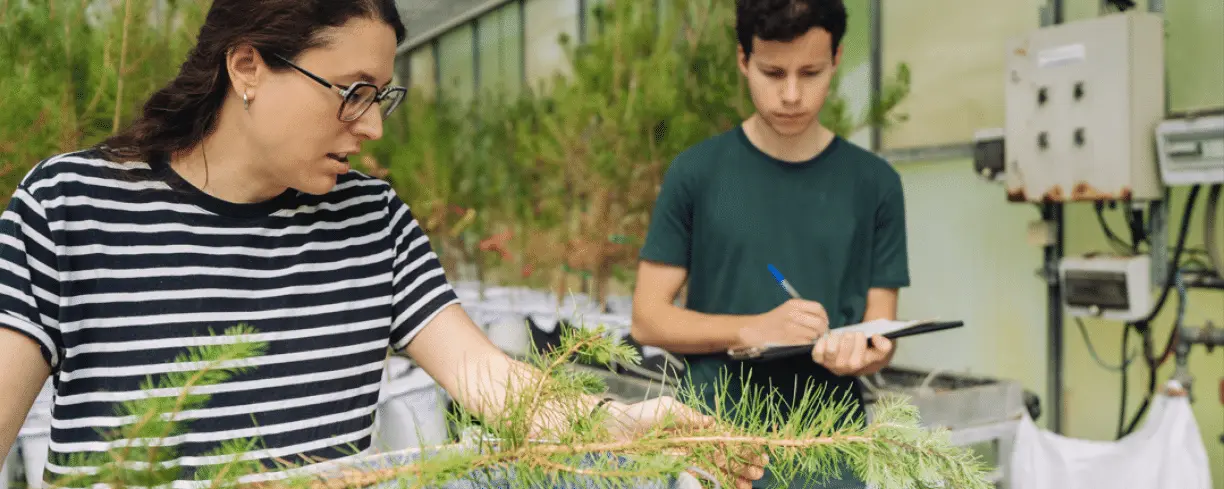
Technicians analyzing the photosynthetic activity of pine trees. Image: Galdric Mossoll

Technique for taking soil samples. Image: Galdric Mossoll

Experimental greenhouse where the growth of pine trees is controlled. Image: Galdric Mossoll
YOU MAY ALSO BE INTERESTED IN
How does water move inside trees?
In a first phase, the project is running an experiment in greenhouses with more than 200 young specimens of Scots pine (Pinus halepensis) , a representative species of Mediterranean forests. The aim is to study how water moves inside the tree both under normal conditions and in drought situations, and in trees of different sizes.
To find out, they use an advanced technique based on isotope-enriched water , a type of invisible dye that allows them to track their path. After watering the trees with water enriched with isotopes of hydrogen and oxygen, the same elements that make up water, laboratory analyses will reveal how much water from internal reserves they use during drought and in which tissues of the tree it is stored.
In a later phase, these experiments will be carried out in a real experimental forest located in Can Balasc, in Collserola, to study it with mature pines, oaks and holm oaks as typical species of the Mediterranean and other parts of Europe, and thus be able to compare the strategies of each. The results will help to build more realistic models of the functioning of forests during drought and to guide the most appropriate management measures to deal with it.
Researcher Trini Torres explains the experiment in this video:
YOU MAY ALSO BE INTERESTED IN