

We are no longer in the phase of major agreements. From Paris, the work is much more technical: how to operationalize the Paris Agreement, how to measure progress, how to finance the measures and how to implement what has already been signed.

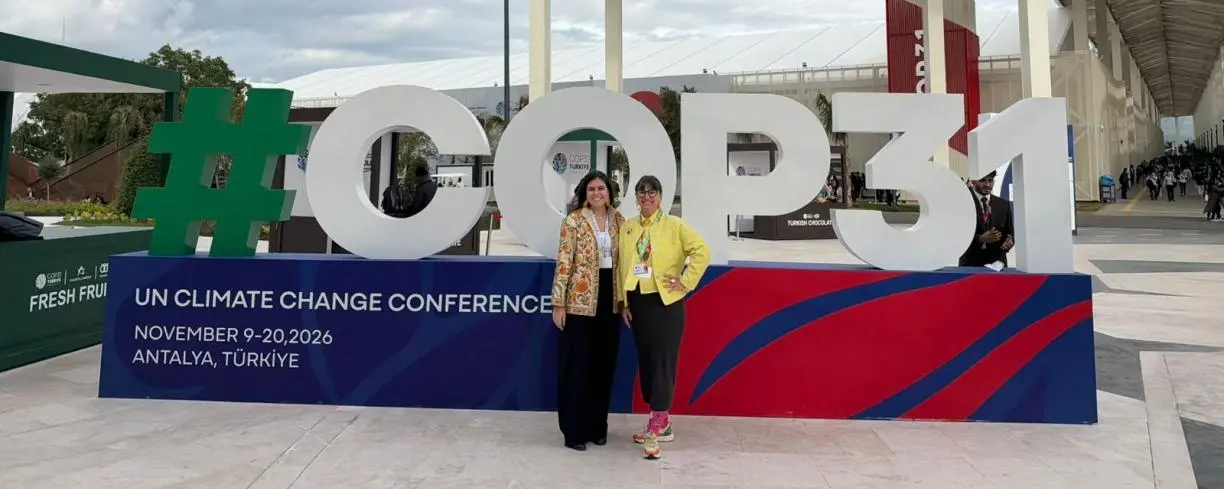
A CREAF delegation formed by Alícia Pérez-Porro and Anna de las Heras Carles, from the center's Institutional Relations and Political Interaction Area, is participating in the 31st Conference of the Parties on Climate Change (COP31), which is being held from November 9 to 20 in Antalya, Turkey. This annual United Nations meeting brings together representatives from almost all countries in the world to negotiate how to deal with the climate crisis, both by reducing greenhouse gas emissions and by preparing for the impacts of climate change that we are already experiencing.
This year, no new major agreement is expected, but progress towards implementing the commitments that countries have already made. In this context, CREAF is participating as an observer entity to contribute scientific knowledge to the negotiations, follow in particular the debates on adaptation to climate change and defend the role of regional and local governments in climate policies.
We are no longer in the phase of major agreements. From Paris, the work is much more technical: how to operationalize the Paris Agreement, how to measure progress, how to finance the measures and how to implement what has already been signed.
Alícia Pérez-Porro, head of the Institutional Relations and Political Interaction Area of CREAF
From promises to action: how do we know if we are adapting?
One of the main objectives of CREAF in Antalya is to follow the negotiations on the Global Adaptation Goal, which seeks to improve the capacity of countries to deal with the consequences of climate change that we are already experiencing firsthand (droughts, catastrophic floods, coastal erosion, low crop productivity, etc.). Adapting means, for example, recovering floodplains to reduce flood damage, creating climate shelters in cities or managing forests so that they are less vulnerable to drought and fires.
At COP30 in Belém, Brazil, countries approved 59 indicators to measure progress on adaptation, but how they should be calculated remains to be defined. This seemingly technical issue is one of the main points of negotiation in Antalya, after the Bonn talks last June ended without agreement.
"A realistic outcome would be to create a technical working group to define how to measure the 59 adaptation indicators that were already approved at COP30 in Belém," says Pérez-Porro. According to the expert, unlocking this process with a clear mandate would be an important step forward, even if it did not generate big headlines.
YOU MAY ALSO BE INTERESTED IN
The difficulty is that there is no single way to measure adaptation. While reducing emissions can be quantified in tonnes of CO₂, preparing for a drought or a flood requires different measures depending on the territory. In addition, it is necessary to ensure that the solutions do not create new problems: for example, infrastructure that protects a city from flooding could increase the risk downstream if it disrupts the natural functioning of the river.
Financing will be another major debate. The most vulnerable countries are demanding resources to implement adaptation measures and believe that compliance with objectives cannot be demanded without guaranteeing the necessary means. This disagreement between countries on how to link indicators to financing is one of the issues that COP31 will have to try to resolve.
CREAF will also closely monitor the role of regional and local governments, which are responsible for implementing many of the adaptation measures on the territory. Decisions on water management, urban planning, natural spaces or the prevention of climate risks depend, in large part, on these administrations.
Adaptation to climate change happens largely at the local and regional level. That is why it is essential that these governments have a voice in international negotiations, that their efforts are taken into account when measuring progress and, above all, that they can access the necessary funding to act.
Alícia Pérez-Porro, head of the Institutional Relations and Political Interaction Area of CREAF
With this participation, CREAF wants to continue strengthening the connections between scientific research and public policies, so that international agreements can be translated into useful decisions to protect people, ecosystems and the territory from climate change.