Sad notes in a disturbing time
All colleagues from the Ecology unit and CREAF are dismayed by the tragic death of Zhijing Yu , a scholarship holder who had chosen the UAB to complete her doctoral studies, certainly with great enthusiasm. An enthusiasm that has been suddenly cut short in a place where it must be assumed that one can do sports safely (it is necessary to know how it is that no one came to her aid and whether or not the surveillance protocol failed)… The death of a young person is a fact that seems terribly unfair, especially in a country where there is no war or any massive catastrophe and when it seems that it could have been avoided. It is a painful grief. The memory of those who knew her and of those who did not but considered her one of our own, will endure as one of the worst moments in the history of our collective.
Less surprising and less tragic is the death of very old people. However, almost at the same time as Zhijing Yu, we lost two people who have stood out in our field for various reasons. One of them is the oceanographer Pepita Castellví . I met her before I finished my degree, when I spent one year (1975-76) skipping morning classes to do a project at the then-called Instituto de Investigaciones Pesqueras, now the Instituto de Ciéncies del Mar. She was a microbiologist at the CSIC and a colleague of Antoni Ballester, a prominent oceanographic chemist. Both of them worked hard to establish a research base in Antarctica in 1988, but shortly after Ballester suffered a serious stroke that took him out of work at the age of 68. He died much later, at the age of 96, in 2017. La Pepita replaced him in the direction of several expeditions and the Spanish Antarctic Base Juan Carlos I on Livingstone Island between 1989 and 1993. Between 1989 and 1995 he directed the National Antarctic Research Program from Madrid and in 1994-95 the Institute of Marine Sciences in Barcelona. For a while she chaired the jury of the International Ramon Margalef Prize (once we had a slight friction because the Jury did not give the prize to EO Wilson and I did not see any candidate even remotely as good, who would have given more prestige to the Prize than Wilson himself and she felt bad that I discussed the Jury's decision; luckily, the same year Wilson was given the Catalonia Prize: Xavier Rubert de Ventós called me on behalf of the jury of this most interdisciplinary prize to ask me if I thought Wilson was a good candidate and I said yes, of course). Pepita, who has always denounced the dangers of global change whenever she has been asked and in her writings, has received numerous awards and has been one of the most outstanding female scientists in the country, since a time when few women could dedicate themselves to science. She died at the age of 90, already retired from research activity.

Josefina Castellví in 'The Frozen Memories', a documentary by Albert Solé / ACN
Antoni Serra Ramoneda , who died at the age of 92, was born into a prominent family dedicated to the textile industry. He was an economist, professor at the UAB, of which he had drafted the statutes in its beginnings and was its Rector between 1980 and 1985. I know from some in Madrid that they called him the Eurorector, because he knew languages, was cultured, elegant, well-built and moved well in relations with the European Community. I began to work with him when he was Rector and I presented to him the project of creating an institute of terrestrial ecology, a project to which he gave firm support, although it did not become a reality until after the end of his mandate, in 1977, under the name of CREAF. He was president of Caixa de Catalunya between 1984 and 2005. Between 1986 and 1991 we were both members of the UAB Appeals Commission and I also had the opportunity to speak with him a few times when the UAB obtained the transfer of the building on Pomaret Street, which meant Serra had to endure long conversations with the now very old former Francoist minister Ramon Serrano Suñer, who was president of an obscure cultural institution that owned it, and when the agreement was made with the UNAM in Mexico (in 1984) that allowed me to travel to visit the experimental areas directed by José Sarukhán, once he had seen ours in Montseny. Another reason for meeting him was the Ecology Classroom, which Anna Àvila and I coordinated, where he gave a very interesting talk. He agreed to participate in the book that Jordi Martínez-Vilalta, Dani Sol and I wrote, Un planeta a la deriva (2011), in which Antoni, Màrius Serra and Joan Manuel Serrat asked us short questions and we answered them at length. We always maintained a cordial relationship with Antoni. Sometimes when we met on the airlift we sat together and the conversation with him was always stimulating. Once, he even came to my house with his wife on an occasion when I gathered some Brassens fans, and he was a big fan, among whom was the long-lost Josep Egózcue. I can't say that we were close friends, but we did get along and I have a very good memory of it.

Antoni Serra Ramoneda in a photograph from 2005. Image Mané Espinosa
In 1998, the Caixa de Catalunya Territori Paisatge Foundation (FTP) was established, with an initial contribution of one hundred million pence and its headquarters in La Pedrera. It was chaired by Antoni Serra and the manager was Josep Maria Sargatal, well accompanied by Miquel Rafa. The objectives were to contribute to the conservation of natural heritage and the landscape, and to raise awareness among all segments of the population about environmental values. I joined the Board of Trustees as a member of the expert group (I signed the acceptance of the position of Trustee at the end of December 1997). On that Board of Trustees were José María Loza, Rosa Caballol, Joan Cals, Ricard Pié, Matías Vives, Josep Maria Espinàs, Victòria Camps, Janine Sehouten, Enric Lluch, Juanjo López Burniol, Joaquim Llach, A. Rodríguez Picó, Juli Esteban, Miquel Perdiguer, RM Llevadot, Ramon Folch, Joaquim Maluquer and others.
This composition changed over the 10 years of the entity's existence, especially when the leadership of La Caixa (president and general director) changed and Narcís Serra and Adolf Todó replaced Serra Ramoneda and Loza. I was always there. I consider that the FTP has been one of the most positive experiences I have had in terms of conservation, especially during the presidency of Serra Ramoneda.
During those years, we worked on the acquisition of important properties and on how to get their management on track. Key pieces were the actions in the Alinyà valley, the recovery of the Ivars and Vila-Sana lakes, the Mont Rebei gorge, the Fraguerau gorge, the Fuster gorge, Port d'Arnes, Mig de Dos Rius, Alt Segre, Aufacada... and the creation of the Planes de Son center (now called MónNatura Pirineus), an important environmental education facility. In addition, the FTP promoted and financed a multitude of projects, from conferences and publications to awareness-raising activities and exhibitions.
Over the course of 10 years, I attended more than forty meetings of the Board of Trustees, plus a number of meetings of the Technical Commission to discuss specific issues and some to evaluate projects. On March 21, 2001, we discussed the Educational Project of the Planes de Son . The construction of the building, which was advanced in environmental aspects, was the reason for many meetings, because it was very expensive and very slow. In addition, I participated in trips of the Board of Trustees to visit Alinyà (June 3, 2000) and Planes de Son (July 29, 2002; inauguration, March 2004).
After the visit to Planes de Son, I wrote a three-page commentary full of criticisms that I believed could improve the subject and other more general ones (about the cost, which is difficult to amortize, and the excessive investment in an isolated emblematic action). In it, I denounced the lack of clear ideas about conservation as it should be understood today (essentially, it is not about conserving things but about conserving processes). I highlighted the importance of environmental aspects not only being taken into account in the construction of the building, but also being made clear to visitors, establishing cooperation programs with research centers and training programs for the local population, astronomical and meteorological observation, etc. In some things they listened to me, in others not so much, but Serra's attitude was always intelligent, balanced and, when necessary, decisive. In 2005, changes at Caixa de Catalunya led to the presidency of the Foundation being taken over by Narcís Serra and in 2008, the foundations of Caixa de Catalunya merged, and therefore, the FTP and its Board of Trustees disappeared, and Sargatal naturally left the management.
I believe that the success of the FTP was due to having sufficient resources, a very active operational team and a Board of Trustees with a large number of people from outside the Caixa, something that changed when all the foundations merged and the Board of Trustees of the resulting entity became composed only of people from the banking entity. Although mistakes were undoubtedly made, I believe that a very considerable task was done and, for me, very rewarding. The disappearance of the FTP has been a very unfortunate consequence of the evolution of the Catalan savings banks and of the banking sector in the State as a whole. Today, CaixaCatalunya belongs to BBVA and the CaixaCatalunya Foundation is an independent entity based in La Pedrera, but it will never have the strength that the FTP had, especially during Serra's time.

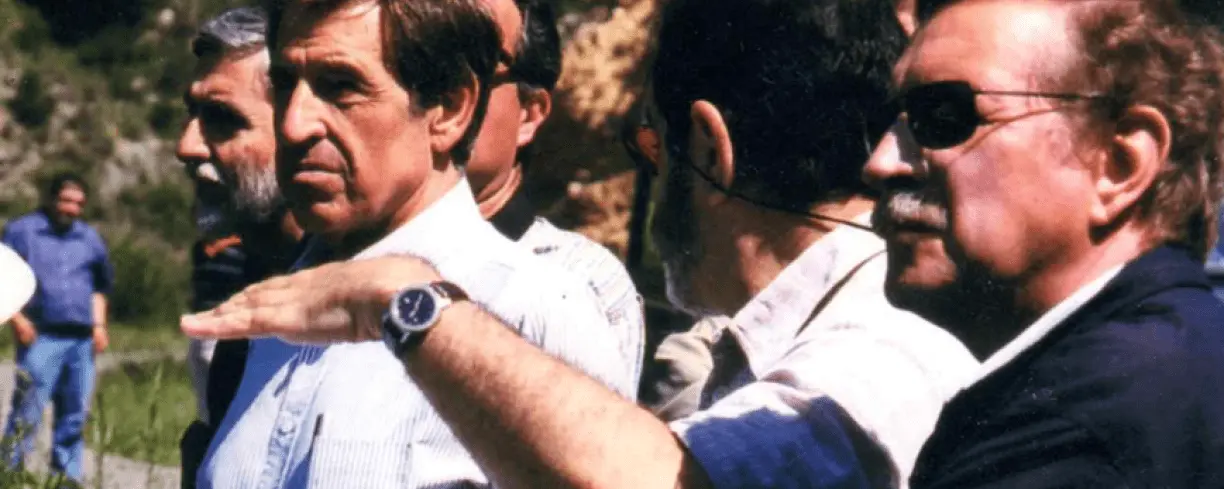
From left to right, me, Serra Ramoneda, Ramon Folch and Juli Esteban during a visit by the Fundació Territori i Paiatge to Alinyà. Behind Serra, covered, Jordi Sargatal.
Meanwhile, winter and the year continue with many reasons for concern. At home, due to the disarray of the commuter trains above all, a disarray that comes from many years of mismanagement, which leaves us, among many lessons, the evidence that the country is facing risks for which it is not prepared, especially those related to climate change. If there is a general bankruptcy of RENFE's railway services right now, it is because the lack of investment for decades has made the infrastructure extremely vulnerable to episodes of extreme weather that will be increasingly frequent. Added to this is political instability on a global scale and the growth of ideologies that serve as a disguise for the defense of interests linked to the use of fossil fuels, on the basis of authoritarianism, of stories that distort reality on issues such as migration, and of the dissemination to everyone of responsibilities for carbon emissions. We will miss the people who, like those I have mentioned here, understood the problems, but the hope is that the number of motivated young people who are acquiring or already have expertise in environmental matters, as was the case of the ill-fated Zhijing Yu, continues to grow. This is an essential contribution from the UAB and CREAF, as well as hundreds of other training and research centers. May the memory of those who have left us continue to be valid and make us stronger because there is a lot of grain to grind.