Every year we receive more than 3000 Mediterranean tortoises from private homes that keep them as pets.


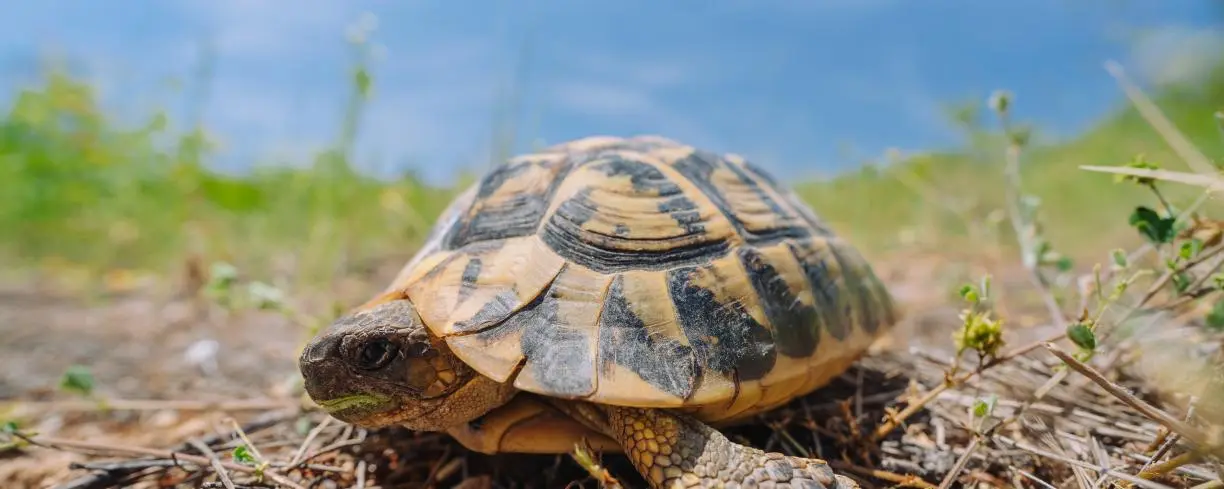
Around the Gaià River, the CustForest project, with the La Sínia Environmental Association, improves the habitat of the Mediterranean tortoise (Testudo hermanni) through forest management in custodial forests.
The Mediterranean tortoise is one of the most emblematic land reptiles of our territory. Despite being protected at the same level as the bear , it remains a vulnerable species, with a very small natural distribution in Catalonia . Today we explain what it is like, where it lives, what it eats and what actions are being taken to protect its habitat.
In nature they have a very small natural distribution, the only natural population nucleus in Catalonia is in the Serra de l'Albera . But it is not the only place where Mediterranean tortoises can be seen in the wild in Catalonia. In several places, such as the Garraf massif, the Montsant mountain range, the Llaberia mountain range, the Ebro Delta, the Ports massif, the Vall Major de Bovera or the natural area of the Gaià river, there are also some thanks to reintroductions that seek to allow this species to recover its distribution in Catalonia.
It may seem paradoxical that this species is listed as endangered, since many people have had them in their homes. However, it is illegal. According to Joaquim Soler of the Amphibian and Reptile Recovery Center of Catalonia (CRARC): “ Every year we receive more than 3,000 Mediterranean tortoises from private homes that have them as pets.”
Every year we receive more than 3000 Mediterranean tortoises from private homes that keep them as pets.
Joaquim Soler, CRARC
Characteristics of the Mediterranean tortoise
Adult Mediterranean tortoises can be between 13 and 20 cm long (shell measurement), and females are usually larger than males. A tortoise can easily live to be 50 years old, so sexual maturity occurs at around 8-10 years, later than most reptiles.
Although the only native tortoise in Catalonia is the Mediterranean tortoise (Testudo Hermanni) , the Iberian Peninsula is also home to another tortoise of the same genus: the black tortoise (Testudo graeca). One way to distinguish it from the black tortoise (Testudo graeca) is by its colouring: the Mediterranean tortoise has black spots on a yellow background, while the black tortoise is darker. In addition, the Mediterranean tortoise has a horny sheath (like a kind of nail) at the tip of the tail and the supracaudal plate (the one above the tail) is divided, while the black tortoise does not.
Normally during the months of April, May or June, the species digs holes in the ground with its hind legs in open areas, between small bushes and preferably with a slight slope to avoid getting stuck in case of rain, as well as facing south or southeast so that there is maximum solar radiation throughout the period. Once it has made the hole, it lays about 3 or 4 eggs, which it will then cover with soil. They can lay two clutches with a difference of 15 days between laying and laying. The eggs are incubated all summer thanks to the ambient temperature and the births begin to be seen at the end of September to mid-October.
Interestingly, the sex of the young is determined by the incubation temperature: if it exceeds 31.5 °C, females are mostly born; if it is lower, males. In this way, the eggs that are located at the top tend to be females because they receive more heat, while the eggs that are buried deeper tend to be males. The proportions of males and females at birth are usually 50%.

How to know if it is male or female?
Female Mediterranean tortoises are usually larger than males. In addition, the plastron (ventral part) of males is slightly concave, while that of females is flat. This makes it easier for the male to position himself on the female during copulation. They can also be distinguished by their tail, which is much longer in males.
| Male | Female |
|---|---|
| Smaller than females | Larger than males |
| Concave plastron | Flat plastron |
| Longer tail | Shorter tail |
What does the Mediterranean tortoise eat?
The Mediterranean tortoise feeds mainly on tender vegetation such as Plantago leaves , various species of grasses and other Mediterranean herbs. It has a very varied diet, and in periods of scarcity it may eat dry plant matter, mushrooms or even herbivore droppings.
When it is very hot in the summer or during the colder months, it greatly reduces its activity. It is capable of estivation or hibernation by burrowing under leaf litter or taking advantage of shady and humid areas, such as the bottoms of ravines. This allows it to withstand extreme temperature conditions and resource scarcity.

Where does it live? Habitat and current distribution
Historically, the Mediterranean tortoise occupied the entire coastal and pre-coastal strip of Catalonia. However, due to changes in the landscape and land use, its natural distribution has been greatly reduced : the only remaining natural population is in the Serra de l'Albera. However, some reintroduction projects make it possible to see it in other areas as well, such as the Ebro Delta, Montsant or the Gaià River.
This animal needs Mediterranean mosaic landscapes: scrublands, meadows, roadsides, cleared holm oak forests and abandoned crops. It avoids dense forests, where not enough light reaches and tender vegetation does not grow. The optimal areas combine open spaces to warm up, vegetation to feed on and cool corners to hide. Although they can be found in unusual places such as closed forests, where densities are low, or by the sea (as in the Ebro delta).

A vulnerable species in danger of extinction in Catalonia
The Mediterranean tortoise has lost much of its original habitat in Catalonia. Urbanization, agricultural intensification, fires, fragmentation of the territory and its past commercialization as a pet (until 1988, when it was included in the animal protection law), caused it to disappear from many areas where it was previously present.
The threats are diverse. One of the main threats was and is the illegal extraction of tortoises. For this reason, every year around 3000 Mediterranean tortoises are collected in recovery centers in Catalonia. Predation also plays an important role in the mortality of tortoises in the environment: wild boars can eat adult turtles and juveniles, hatchlings or eggs can be preyed on by foxes, skunks, rats or corvids. Climate change also plays a role: increasingly long and extreme droughts can cause the death of hatchlings from dehydration.
The most important threat, however, is the alteration of their habitat, as land use change and the construction of roads and urbanization contribute to the isolation of populations. In addition, intensive agriculture and the use of herbicides directly affect the food available to the tortoises.
In light of this, several projects are working to improve habitats, strengthen populations and mitigate the effects of threats.
The Mediterranean tortoise around the Gaià River
One of the places where a reintroduction is being carried out is around the Gaià River, in the Gaià River Protected Natural Area - Albereda de Santes Creus. It is important to carry out these reintroductions in spaces where the individuals can survive because they have a suitable habitat and can find food and shelter.
Recovering this species is not an easy task and there are people who dedicate themselves to it every day. For example, the La Sínia Environmental Association is actively working to improve the habitat for the turtle around the Gaià River. Water and shelter are two key elements to ensure the survival of the turtles, and for this reason they have installed water points and shelters, spaces where the turtles can take refuge.
But all this is useless if the habitat is not suitable: tortoises need open spaces where they can sunbathe and where they can find tender shoots and other food to eat. To solve this, this association is working within the CustForest project, carrying out a series of actions to open up spaces to benefit the Mediterranean turtle and other species associated with open habitats , such as the Bonelli's eagle. Andrea Córdoba, from La Sínia, explains it this way: "We carry out selective and manual clearing to avoid as much as possible any disturbance that could affect this animal or others. We also do it outside the breeding period to disturb it as little as possible."
This work is carried out following the scientific and technical advice of CREAF, and monitoring is carried out to ensure, over time, that the actions are effective.

We carry out selective and manual clearing to avoid as much as possible any disturbance that could affect this animal or others. We also do it outside the breeding period to disturb it as little as possible.
Andrea Córdoba, La Sínia Environmental Association
What can I do if I find a Mediterranean tortoise?
How lucky! Finding a Mediterranean tortoise is not easy at all, its distribution and population density make the find a real gift. The most important thing is that you do not touch it and enjoy the tortoise without disturbing it. If the tortoise is in danger because it is in the middle of a road, for example, you can move it off the road, if you do it with gloves, the better.


El projecte CustForest compta amb el suport de la Fundación Biodiversidad del Ministerio para la Transición Ecológica y el Reto Demográfico (MITECO) en el marc del Pla de Recuperació, Transformació i Resiliència (PRTR), finançat per la Unió Europea – NextGenerationEU.
YOU MAY ALSO BE INTERESTED IN