
Science can help improve management and predict impacts, such as sea level rise and extreme events like flash floods


Science has made its voice heard at the annual MedCat Days 2025 meeting in Barcelona, a space for dialogue and political advocacy aimed at analyzing the context and major challenges facing us in the Mediterranean. This year, the focus has been on the New Pact for the Mediterranean, 30 years after the Barcelona Process. Among the objectives of this event is contributing to the deployment of European policies with an impact on the Mediterranean basin, with a special focus on the urgency of climate change , as highlighted at the opening ceremony by Jaume Duch, Minister of the European Union and External Action of the Government of Catalonia. The Catalan government, the European Institute of the Mediterranean, and the European Commission are promoting this annual event, which was attended by Dubravka Šuica, European Commissioner for the Mediterranean.
At this forum, CREAF researcher Annelies Broekman shared the results and actions of projects promoted within the context of the Mission for Natural Heritage of the Interreg EURO-Med scientific program, which has the seal of the Union for the Mediterranean. Specific actions on green entrepreneurship, sustainable tourism , the promotion of green areas , and the promotion of the maritime economy in direct contact with the fishing sector in the southern and northern basins of the Mediterranean were also highlighted. Furthermore, the event's agenda included Alicia Pérez-Porro, Head of Political Interaction and Institutional Relations at CREAF. Research and science were also represented thanks to the interventions of Ana Pérez, Director of the Centre Tecnològic de Telecommunications of Catalonia , as well as Sergio Ponsá, Director of the Beta Technology Center , and part of his team represented by Mercè Boy and Maria Calderó.
Science can help improve management and predict impacts, such as sea level rise and extreme events like flash floods
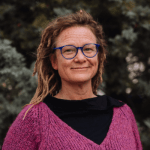
Annelies Broekman
Science and political maturity
The need for political and human maturity, along with collaboration with science, was the starting point for researcher Annelies Broekman's presentation as part of the roundtable on smart and green solutions through territorial cooperation and community empowerment. Broekman spoke about the Mission for Natural Heritage and its objective of promoting transfer to protect and restore functioning ecosystems and, ultimately, to reduce our vulnerability to climate change. Some examples in Catalonia with active pilot cases are LocAll4Flood (led by the Beta Technology Center) and MPA4Change (led by the ICM). Likewise, this scientific project produces evidence-based knowledge aimed at political action and, as an example, has provided concrete recommendations and key knowledge for those responsible for developing the European Nature Restoration Law regarding marine ecosystems and terrestrial ecosystems, such as forests and freshwater bodies.
YOU MAY ALSO BE INTERESTED IN
"We must base prosperity on the health of ecosystems, because everything we're discussing here today depends on it", the scientist stated, emphasizing knowledge exchange and collaboration among entities in the Mediterranean region facing shared challenges. "Functioning ecosystems are extremely degraded, and climate change is putting even more stress on them," she recalled.
Regarding the recent flash floods, Broekman called for robust actions based on Nature-Based Solutions , which inspire the proposals of the Interreg-EURO Med program. The researcher linked these extreme events to the need for governance models that include at-risk populations and allow for better preparedness. "Science can help improve management and anticipate impacts, such as sea level rise", she recalled. "We must value lived experiences and monitor the state of nature, establishing a dialogue with all stakeholders, because there are no magic bullets", also mentioning the ecoystem and human health concepts.
YOU MAY ALSO BE INTERESTED IN
Sitting at the negotiation table
In addition to informing public policy, along with other disciplines, "the role of science must include sitting at the negotiating table", stated Alicia Pérez-Porro, who also insisted that in the Mediterranean, we share "a climate identity that is suffering greatly". The head of political interaction at CREAF noted that the tropicalization effect of the Mediterranean Sea, the drought, and its impact on food security all have a scientific component.
Responding to the concept of a multi-stakeholder vision of the New Pact for the Mediterranean, Pérez-Porro called for the importance of a scientific profile, which simultaneously understands public policies and can therefore inform them. "Science diplomacy unites us and leads us toward building peace", she asserted, insisting that "science is also a way of uniting, of going beyond research projects to mitigate the negative effects of climate change".
The New Pact for the Mediterranean , which gave meaning to the event held in Barcelona, is a roadmap from Ursula Von der Leyen's government, which will be made public in mid-October 2025. It has included input from multiple voices from areas as diverse as civil society, the economy, science, academia, and the southern and northern shores of the Mediterranean.
WITH THE COLLABORATION OF:
This publication is part of the «Severo Ochoa» Centres of Excellence programme, Ref. CEX2023-001340-S, funded by MICIU/AEI/10.13039/501100011033.