I've learned that art offers a different way of looking at processes and phenomena we took for granted, allowing us to reinterpret them from new perspectives. I've also learned that collaboration between seemingly disparate disciplines can find ways to explain complex ideas beyond the academic sphere. I was surprised that the carbon cycle could be related to a play, and even more so that this connection now seems obvious to me. This was the first time I've tried not to oversimplify my work for a non-specialist audience. I set out to explain the concepts while maintaining their complexity, and I ended up learning as much as in any stage of research.
A fable about the carbon cycle is the result of the interaction between science and art at CREAF

Artists and scientists presented the fruits of their collaboration in the Hangar room through a performative lecture entitled “ Fins que el principi em torne al final” (Until the beginning returns to the end ). In the work, six scenes, repeated every ten minutes, simultaneously depicted diverse images and metaphors related to the carbon cycle. The whole brought to life a visually powerful ecosystem that reflected how carbon circulates, accumulates, and is released repeatedly on different timescales.
You probably remember some of the fables you were told in your childhood, endearing stories where unexpected protagonists, like a tortoise, a hare, the wind, or the sea, discover something about themselves and condense it into a small lesson. What if we wrote a fable where the protagonist was carbon? This is the path taken by CREAF researchers Estefanía Muñoz and Filipe Andrade, along with artists Ximo Berenguer, Ana Moure, and Carlos Pastor, from the collective La cuarta piel, accompanied by Paula Bruna as curator of the first Jaume Terradas artistic research residency . This residency is an initiative of ECOTONS, CREAF's art and science group, which seeks to create spaces where both disciplines can engage in dialogue and mutually enrich one another.
The viewer could walk through the space between each of these scenes and observe them one by one at their own pace. The connecting thread was a story read aloud by four people illuminated by a dim light. To their right, three workers simulated taking air and soil samples. In the background, a couple shared a passionate kiss. In another corner, a looped video offered a view of the Collserola forest through night-vision goggles. In the center of the room stood two sculptures. One, an axe, represented the violence with which humankind alters the carbon cycle. The other, a drone, suggested a paradox: the technology we use to observe nature causes carbon to observe itself. Both were simultaneously weapons and jewels, alluding to the duality of our creative capacities.
Rather than telling a story, the performative lecture presents a situation: a cycle that is embodied, overflows, and repeats itself. A stage device that proposes experiencing carbon not as data, but as material drama, as an inescapable relationship between life, technology, and territory.
All of this, enveloped by the acousmatic music of the French composer Èliana Radigue, constructed an experience that presented the carbon cycle, beyond the scientific explanation, as a cultural narrative traversed by the social, literary, political, mythological and economic gaze.
Although the performance only took place over one afternoon, it can be relived thanks to a video recorded by photographer and directed by Tristán Pérez-Martín. You can watch a summary video or the complete performance .

A common language between science and art
A common language between science and art
Estefanía Muñoz investigates the timescales of the carbon cycle in terrestrial ecosystems by collecting air samples in large glass ampoules, which she then transforms into graphite in the laboratory. Filipe Andrade, on the other hand, studies the carbon balance in ecosystems using samples of branches, trunks, leaves, and soil. The artists explain that when they arrived at CREAF they knew nothing about the carbon cycle and describe it as “Vulcan’s forge,” a place where objects and narratives are created simultaneously.
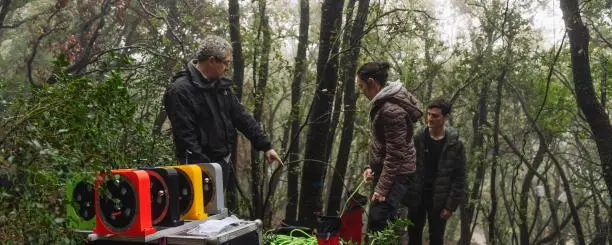
Their perspectives became increasingly intertwined throughout the process. In one of their meetings, they participated in a creative writing workshop using the exquisite corpse technique, which allowed each participant to expand their initial knowledge through text and drawing. They also visited the Can Balasc biological station in the heart of the Collserola forest on several occasions. There, they shared days of fieldwork and walks through the woods, discovering what the eyes of an artist and those of a scientist notice (and what they don't).
The conclusion they have reached is that art and science share a very clear objective, to know the world, and that there are also many similarities between how a scientific laboratory and an artistic one work.
There has been a complete exchange of terminology and concepts, and just as the artists have come to understand what the carbon cycle is, the scientists have gained a better understanding of what a performance is and what it truly seeks to achieve. The success of the residency has been precisely this synchronization: finding a common language between science and art, which seemed very distant, but which later turned out not to be so far apart.
YOU MAY ALSO BE INTERESTED IN
YOU MAY ALSO BE INTERESTED IN

This was my first curatorial experience, and I'm very happy with the entire process. I learned a great deal, both in the search for artistic practices that could engage with CREAF's research and in the subsequent support of the project. It was surprising to see how, upon encountering each other, many commonalities emerged between science and art—commonalities that the distance between disciplines often obscures, from the scientists' rich cultural background to the artists' methodological rigor. The scientists' willingness to go beyond the data and delve into subjectivity and narrative was key to this process. La cuarta piel was able to channel all of this and give it a carefully crafted artistic form. This fusion became evident in the final performance, which was entirely hybrid in form, content, and participants.
The dialogue between science and art continues
The dialogue between science and art continues
This fruitful interaction has been very positive for both parties, and the project will take on a life of its own beyond the residency. Both the artists and the scientists have expressed interest in continuing to collaborate and already have several conferences and events lined up where they can present their work. They are also exploring the possibility of seeking new sources of funding to take the performance from the stage to the screen and turn it into a feature film.
For now, the results of this first residency will be compiled in a booklet summarizing the collaborative process and its outcomes. Meanwhile, at CREAF, the ECOTONS group and Paula Bruna have already begun exploring the second edition of the Jaume Terradas residency , starting with an internal search to identify CREAF research groups interested in participating, and then finding artists whose work aligns with the themes and practices of these teams. And so, the cycle begins anew.

The testimony of the artists
The testimony of the artists
CREAF has had the pleasure of working with artists Ximo Berenguer , Ana Moure, and Carlos Pastor, from the art collective La cuarta piel. For them, the process has opened new avenues for shared research between art and science, and they emphasize the profound affinities they have discovered between the two disciplines. They also highlight the human connection fostered by the residency and look to the future.
What have you learned in this residence?
What have you learned in this residence?
"Besides learning fundamental concepts about the carbon cycle and testing new forms of shared artistic research, the residency has allowed us to truly experience what it means to think together from different disciplines. We have learned not only content, but also ways of seeing: how scientific research can open itself to theatrical, poetic, and speculative languages without losing rigor, and how art can become a tool for translating complex processes into sensory experiences. Above all, we have confirmed the importance of narratives and metaphors for explaining the world. In a time of climate crisis, we feel that knowing the facts is not enough: we need to construct images, fictions, and forms of storytelling that resonate with us and transform us."
What do you take away from the process?
What do you take away from the process?
"We gained so much from the human connection that developed during the residency: the generosity of the CREAF team, the opportunity to engage in dialogue from different perspectives, and the feeling of having built a genuine space of trust between art and research. We also gained a transformation in our perspective. After this process, carbon no longer appears to us as an abstract or purely scientific concept, but as an everyday presence, almost as an agent that permeates bodies, materials, atmospheres, technologies, and landscapes. In a way, it has become ubiquitous in our daily perception, and this modifies the relationship we establish with the environment and with the scale of the processes that sustain life. The project itself stems from this idea of the ubiquity of carbon and its continuous circulation among humans, non-humans, and technologies."
What surprised you most about the residence?
What surprised you most about the residence?
"Perhaps one of the things that has surprised us most has been discovering certain profound affinities between science and art. They are often presented as separate fields, but in the process we have seen that both construct mechanisms for observing, formulating hypotheses, exploring possibilities, and producing meaning. In the laboratory, small, controlled worlds are created where the interaction of certain elements is observed; in art, especially through speculative fiction or performance practice, provisional worlds are also constructed where relationships, tensions, and questions are explored. We have been very interested in this point of contact: the possibility of 'betraying' science not to deny it, but to shift it toward myth, tragedy, or fable, and from there open up other forms of understanding. This idea is at the heart of the project's public presentation."
What's the next step?
What's the next step?
"We would like to emphasize that this research does not feel closed, but rather like the beginning of a long journey. The residency has left a sense of continuity, the intuition that there is a fertile line of work here that can still unfold. We are eager to continue collaborating, delving deeper into this intersection of art, ecology, and narrative, and to continue building a cultural device or product that can circulate, transform into other formats, and reach diverse audiences. We also believe that one of the project's strengths lies precisely there: in that it is not exhausted by a single presentation, but rather opens up a field of research and cultural mediation that can continue to grow and find new forms of existence. The public presentation at Hangar was, in fact, conceived as a performative lecture composed of simultaneous scenes that simulate a living ecosystem, which reinforces this vocation of an open and expandable work."
YOU MAY ALSO BE INTERESTED IN
YOU MAY ALSO BE INTERESTED IN