Project / Initiative
National projects
-
Active
DRYLAND
Drought as an emerging driver of soil carbon and nutrient losses and water quality degradation in high mountain ecosystems

Creaf leader

Participant

Participant
Droughts are among the most severe consequences of climate change, with far-reaching ecological and socioeconomic impacts. However, despite the critical role of high-altitude regions as freshwater sources and water towers for the water supply of world population, the effects of drought on soil biogeochemistry and downstream water quality remain poorly understood. DRYLAND aims to fill this knowledge gap by investigating how drought alters the biogeochemical processes governing the mobilization of carbon, nutrients, and inorganic across the soil-stream continuum in high-mountain catchments.
The project integrates three interconnected research approaches. First, a controlled drought manipulation experiment (WP1) will analyze microbial destabilization mechanisms, carbon and nutrient retention, and exports via leaching and greenhouse gas emissions in peatland and mineral soils under drying and rewetting phases. Second, high-frequency field monitoring (WP2) will use multi-sensor platforms and well networks to track the hydrological and biogeochemical dynamics in soil-stream interfaces during natural drought events. Finally, retrospective water chemistry analysis and predictive modeling (WP3) will assess past drought impacts and simulate future scenarios to predict changes in water quality at a regional scale.
DRYLAND will generate critical scientific knowledge to anticipate and mitigate the cascading effects of drought on soil stability, nutrient cycles, and freshwater quality. This interdisciplinary project stands at the forefront of climate change biogeochemistry, being the first one to quantify soil biogeochemical responses to drought in high-mountain environments using cutting-edge isotopic techniques, microbial physiology assessments, and high-frequency sensor monitoring and predictive models. It will also offer new insights into the mobilization of legacy pollutants, including heavy metals, under drying-rewetting cycles, with implications for both ecosystem and human health. This knowledge will enable the development of adaptive strategies for sustainable water use, pollution control, and climate mitigation in vulnerable mountain ecosystems, aligning with European environmental priorities and supporting Sustainable Development Goals in climate change mitigation, biodiversity conservation, and ecosystem resilience.
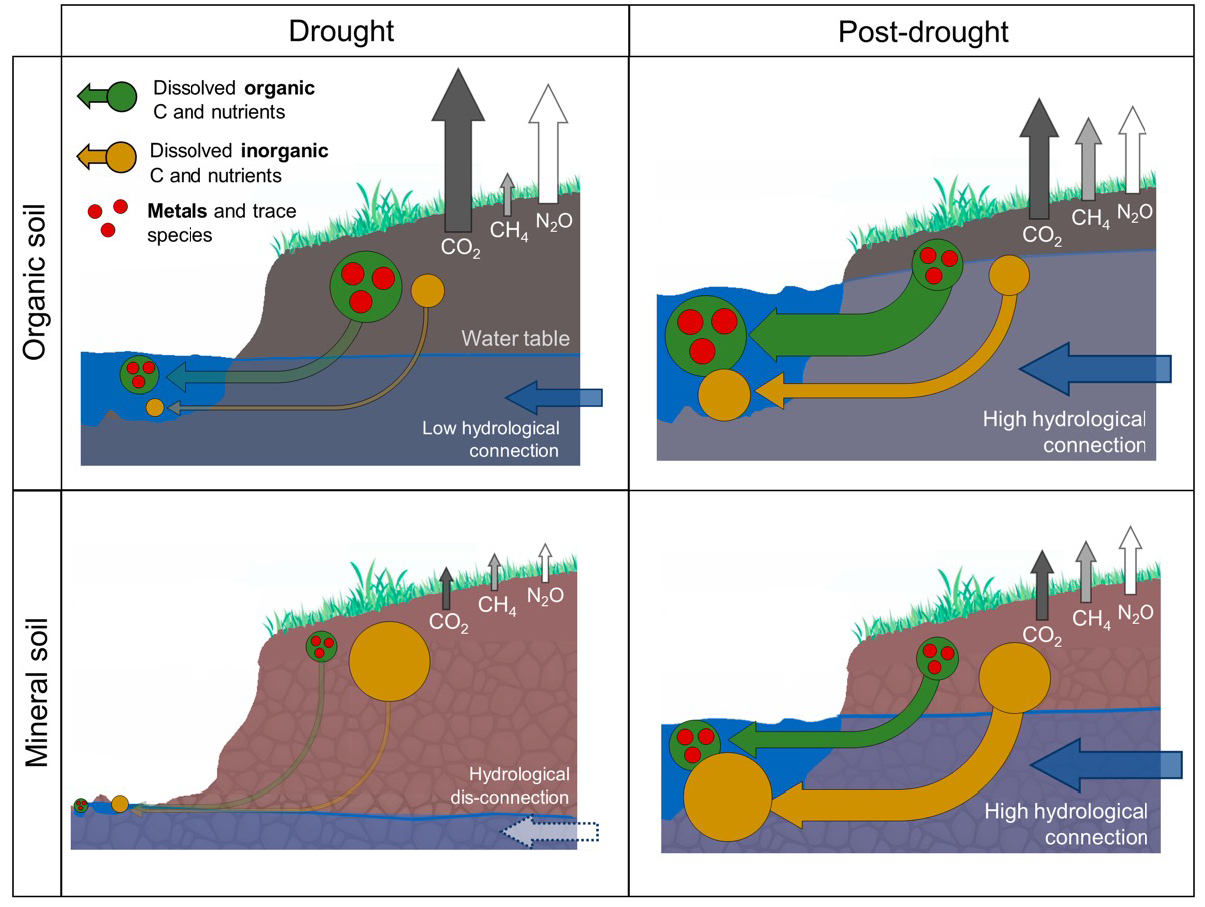
Hypothesis of the effects of droughts on the regulation of soil biogeochemical cycles and water quality of high-mountain regions. Conceptual description of a hypothetical drying (left panels) and rewetting (right panel) cycle in a peatland (upper panels) and a mineral (bottom panels) soil-stream interface, including expected hydrological connectivity, and potential consequences for the export fluxes and pool size of various biogeochemical elements.
FINANCING
Proyecto PID2024-162937OB-I00 financiado por MICIU/AEI /10.13039/501100011033 y por FEDER, UE