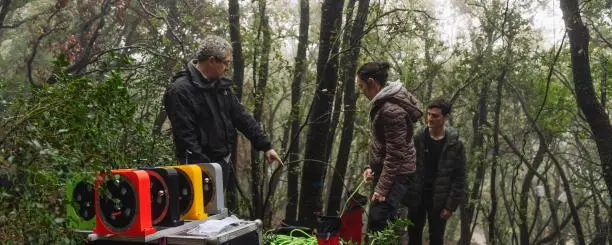
In her day-to-day work in the lab, Kate Johnson studies how plants respond to extreme climates, such as droughts or freezing temperatures. To do this, she uses microscopic-level imaging techniques, such as cavitation imaging cameras and X-rays. Marc Busuldu, for his part, aims to improve the algorithms used to estimate the water status of forests from remote sensing images, such as those captured by satellites or drones. For now, he spends hours on end in the lab studying how different leaves react when exposed to electromagnetic pulses, depending on the proportion of tissue, water, and air in each one. Both work at different scales, but they share a common philosophy: to avoid, as far as possible, harming the plant they study.
The search for artists with a similar sensitivity to observing the plant world led, during the curatorial process, to María Castellanos and Alberto Valverde. They have been working together since 2009, particularly on artistic research processes that involve interaction with scientists. While María holds a PhD in Fine Arts, Alberto is also a technologist who works with mathematical and predictive models.
"What excites us most about this residency is building knowledge through a dialogue between art and science. We're interested in the exchange being reciprocal: for scientific research to inspire and transform our artistic practice, but also for the artistic process to bring new perspectives to scientific research. We hope this encounter generates new questions and opens up new paths of exploration."