

Historically rare, they used to occur once every hundred years, but with climate change, it is estimated that they could occur more frequently and last longer.

Scrubland and grasslands cover nearly half of the planet and accumulate more than 30% of the world's carbon reserves. A study published today in Science warns that extreme and prolonged droughts cause much more serious losses in plant productivity—the creation of new organic matter through photosynthesis—in these ecosystems than a single year of intense drought or several years of moderate drought. The study analysed experimental data from 74 grassland and shrubland ecosystems on six continents and reveals that not all regions of the planet will suffer equally from the effects of extreme droughts. The results show that arid and semi-arid areas, such as the Mediterranean, the southwestern United States, southern Africa and Central Asia, are the most vulnerable. The work was led by Timothy Ohlert and Melinda D. Smith, researchers at Colorado State University, with the participation of 120 international institutions, including CREAF, the Global Change Research Institute at Rey Juan Carlos University (IICG-URJC), the Spanish National Research Council (CSIC) and the Pyrenean Institute of Ecology (IPE-CSIC), among other Spanish entities.
Specifically, the results show that after four years of extreme drought, the average loss of plant productivity doubles compared to moderate droughts. This would jeopardise the ability of scrubland and grasslands to absorb carbon dioxide from the atmosphere and store it in their biomass (leaves, branches and stems) and in the soil globally. In addition, essential activities such as livestock farming could be compromised, as animals depend on pastures for food; and agriculture, because, among other things, scrubland and grasslands act as natural barriers against erosion and are reservoirs of biodiversity, for example, they harbour pollinators and microorganisms that are beneficial to crops.
Historically rare, they used to occur once every hundred years, but with climate change, it is estimated that they could occur more frequently and last longer.
According to the team, the most damaging droughts are those that involve a shortage of rainfall over several years and are extremely intense. “Historically rare, they used to occur once every hundred years, but with climate change, it is estimated that they could occur more frequently and last longer”, says Josep Peñuelas, a CSIC researcher at CREAF and co-author of the study.
Biodiversity and humidity lose their protective effect
The study reveals that the most severe impacts of extreme droughts are concentrated in arid and semi-arid regions, such as the Mediterranean, where water shortages can cause profound changes in species dynamics. In these ecosystems, prolonged droughts can interrupt the emergence of new plants or drastically reduce their fertility, jeopardising the survival of the most sensitive species. Added to this is greater variability in the rainfall cycle and high solar radiation, which increases temperatures and causes more water to evaporate.
In contrast, wetter grasslands and scrublands, such as those in northern Europe or the north-central United States, are more resistant to moderate droughts thanks to their greater diversity and availability of water, among other factors. However, researchers warn that when extreme droughts recur for several consecutive years, even these ecosystems lose their resilience and see their productivity fall by up to 160% more than under moderate conditions, an increasingly likely risk under the current climate change scenario.
YOU MAY ALSO BE INTERESTED IN
Decades of local study in a global framework
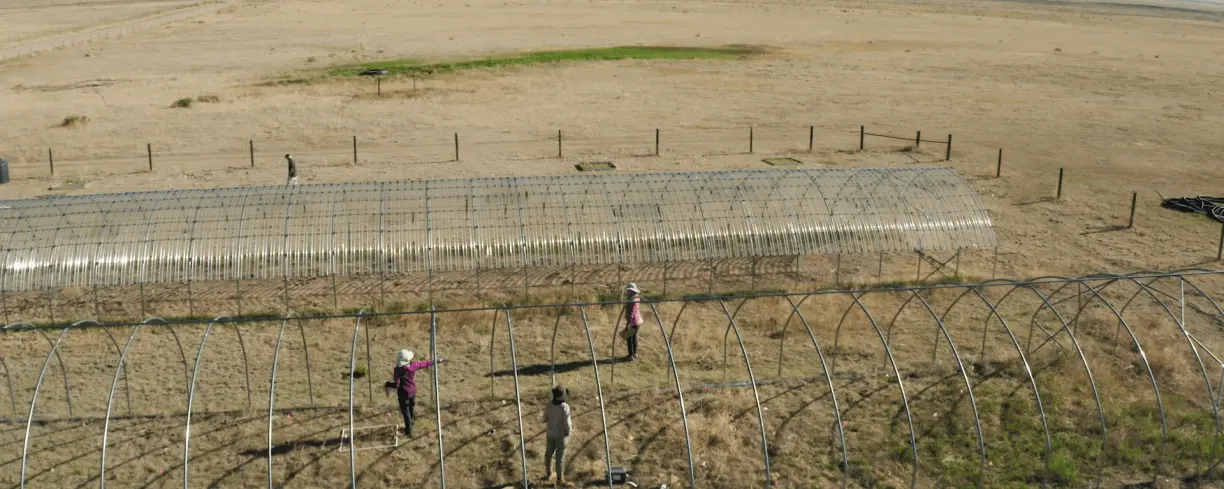
The research is part of the International Drought Experiment (IDE), the largest global experimental network dedicated to studying the effects of drought, with more than 170 researchers. The design of the experiment is unique because it has been replicated in a similar way at all 74 study sites, which cover different climatic, soil and species characteristics. To carry it out, the teams have built rain manipulation structures that reduce each precipitation event by a certain amount. This demonstrates how widespread and globally significant the impacts of extreme droughts can be.

Since the late 1990s, we have been conducting experiments on the impact of drought on grasslands and scrublands. This provides us with very valuable and reliable data, which we have been able to contribute to this research.
In the case of CREAF, the experimental plots it has studied are located in El Garraf (Catalonia, North East Spain), remain active and are among the oldest in the world: "Since the late 1990s, we have been conducting experiments on the impact of drought on grasslands and scrublands. This provides us with very valuable and reliable data, which we have been able to contribute to this research", according to Romà Ogaya, a researcher at CREAF, co-author of the study and coordinator of the field experiments. Meanwhile, the IICG-URJC has now accumulated 10 years of sampling in annual scrubland and grasslands in the south-east of the Community of Madrid, at the experimental facility set up on the El Espartal estate (Ciempozuelos): “Although the work now published focuses on four-year intervals, the study shows the importance of maintaining long-term experimental studies”, points out Ana M. Sánchez, a researcher at the IICG-URJC.
For its part, the IPE-CSIC was responsible for compiling data obtained from subalpine pastures in the Aragonese Pyrenees. Six monitoring plots were established there, three of which were treated for drought and three of which were monitored for five years for plant productivity, in addition to other complementary climatic and soil variables. Plant productivity in the study area was less affected after the drought experiment compared to more arid areas or those that had suffered more extreme or prolonged droughts. “This highlights the great usefulness of coordinated studies to gain a deeper understanding of the expected impacts of droughts based on the specific conditions of each region”, explains Yolanda Pueyo, senior scientist at IPE-CSIC.

Researchers in the experimental plots in Garraf (Catalonia). Author: Romà Ogaya.

Experimental plots in the Garraf (Catalonia). Author: Romà Ogaya.
“This major global research effort is truly a team effort and provides a platform for quantifying and further studying how the impacts of intensified droughts could develop”, concludes Melinda D. Smith, one of the lead authors and a researcher at Colorado State University in the United States.
Several Spanish institutions participated in the study, including CREAF, the CSIC, the Pyrenean Institute of Ecology (IPE-CSIC), the Global Change Research Institute at Rey Juan Carlos University (IICG-URJC), the University of Cádiz, the University of Alicante and the Complutense University of Madrid, along with numerous international centres.
Reference article: Ohlert, T., Smith, M. D., Collins, S. L., Knapp, A. K., Dukes, J. S., Sala, O. E., Wilkins, K. D., Munson, S. M., Anderson, M. I., Avolio, M. L., Chen, A., Hayden, M. T., Holdrege, M. C., Slette, I. J., Wilfahrt, P., Beier, C., Fraser, L. H., Jentsch, A., Loik, M. E., Luo, Y., … Zuo, X. (2025). Drought intensity and duration interact to magnify losses in primary productivity. Science. DOI: 10.1126/science.ads8144