

I think it enriches us greatly to be able to create among all these informal spaces to learn, catch up on what our colleagues are doing and discover that we have many things in common that we wouldn't necessarily realize in our day-to-day lives.

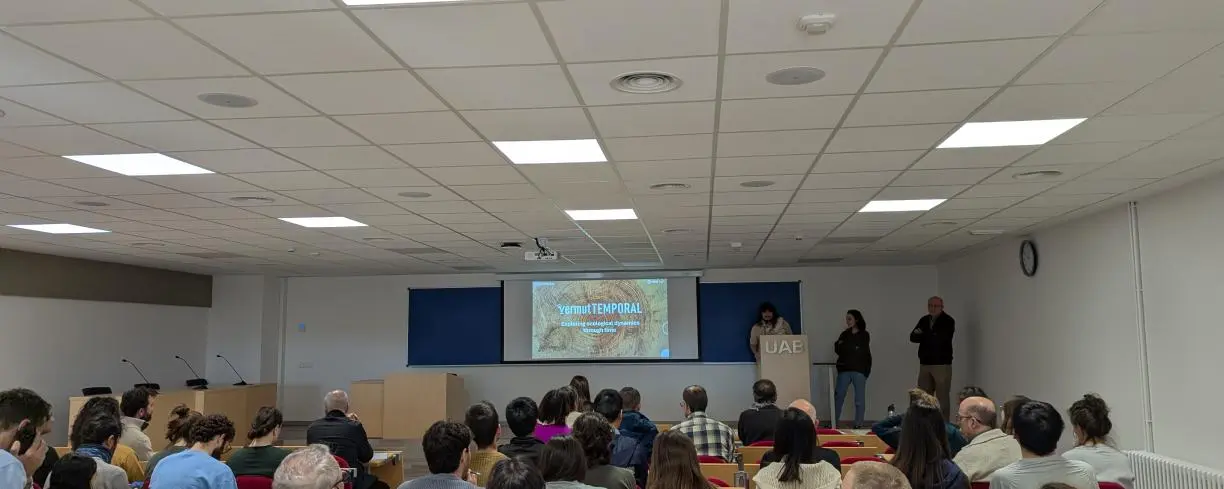
Who said that time travel was impossible? At CREAF, all we have to do is meet in the same room, put our knowledge on the table and let science do the rest. The fourth edition of the thematic 'vermuts' , an internal initiative that brings together the center's staff to share projects and discover synergies , has once again filled the house with almost 100 colleagues ready to go through 18 talks under the same common thread. This year, the edition has focused on a key question in ecology: what happens to ecosystems as time passes and what do these changes tell us? That is why it has been named VermutTemporal.


A multitemporal look at ecology
The 18 presentations revealed a common element: the temporal dimension is present in almost all CREAF research , whether to understand current processes or to reconstruct long-term ecological histories. The studies operate at very diverse scales and resolutions, from daily monitoring of bird behavior or embolism in trees to paleoecological research spanning millennia.
Part of the center's research records changes in real time , thanks to continuous monitoring of ecosystems, measuring stations, automatic cameras or satellite technologies. Other projects recover the past through natural and historical archives , such as tree growth rings , lake sediments or museum collections, which allow the reconstruction of long-term ecological processes. Some studies also take advantage of open research data - both historical and recent - which expand the time scale of analysis and allow trends to be compared at different points in time. Finally, there were presentations focused on analysis and interpretation tools , such as the analysis of ecological trajectories developed by CREAF's Ecosystem Modelling Facility , which helps to compare patterns and dynamics at the scale of ecosystems.
All of this demonstrates CREAF's commitment to a multi-scale and multi-temporal ecology, capable of connecting observations of hours or days with perspectives that extend over decades, centuries or even millennia.
YOU MAY ALSO BE INTERESTED IN:
The vermuTEAM: the gear that makes each edition possible
Behind the vermouth is the vermuTEAM, a captivating team that ensures that everything runs smoothly: from defining the theme and scheduling the event to mobilizing speakers and the public, coordinating communication and ensuring that the 5+5 format flows like clockwork. Led by Alba Bofill , CREAF's scientific coordinator, with the support of Florencia Florido , open science and knowledge management technician. This team accompanies the ambassadors throughout the process and creates the conditions for the day to be agile, diverse and welcoming.
I think it enriches us greatly to be able to create among all these informal spaces to learn, catch up on what our colleagues are doing and discover that we have many things in common that we wouldn't necessarily realize in our day-to-day lives.
Alba Bofill

The fact that there are 80 people gathered for more than 3 hours cannot be explained only by the promise of a snack (vegetarian by default). There is clearly a need to know what they are doing in the lab next door, to learn from the creative minds of the PhD students and to collaborate on new projects. It is Open Science in all its glory!
Florence Florido
Stop, look and listen to each other
Thematic vermouths have become much more than an annual symposium. They allow CREAF to look in the mirror and recognize the richness of its research with face-to-face meetings that give rise to leisurely conversations, to discover shared paths and to understand everyone's work with a broader perspective. The day also always culminates with a pica-pica, where ideas and reflections continue to flow accompanied by a vermouth that happily pairs with the energy of the moment.
After exploring forestry research , biodiversity and ecosystem services in past editions, this fourth edition dedicated to the passage of time in ecology consolidates Vermuts as a space that ensures internal knowledge of the center's research and feeds the CREAF scientific community.

VermutTemporal is part of the Severo Ochoa ECO-RESILIENCE 360 excellence program, which aims to promote cutting-edge research and strengthen CREAF's position on the international scientific scene. Specifically, it contributes to Action 1.1, aimed at promoting synergies between researchers and groups at the center.
This publication is part of the «Severo Ochoa» Centres of Excellence programme, Ref. CEX2023-001340-S, funded by MICIU/AEI/10.13039/501100011033.