
In particular, with dendrometers we can ‘listen’ to the heartbeat of a tree: the trunk contracts when it empties of water and expands when it fills with it through the roots.


In the heart of the Collserola Natural Park, the forest hides much more than it seems. Among trees and undergrowth, CREAF researchers deploy a true open-air laboratory: dendrometers that “listen” to the heartbeat of trees; antennas that capture signals from satellites thousands of kilometers away; sensors that record almost in real time temperature, humidity or photosynthesis; and equipment that scans trees to make a digital copy of their exterior.
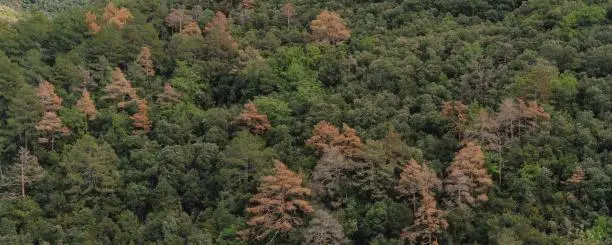
All of this to understand how Mediterranean forests respond to drought and to improve prediction models and data visualization tools such as ForestDrought from the Catalan Forest Laboratory. This information also becomes key to understanding fire risk in an area, because the drier the vegetation, the more likely it is that fire will spread.
Collserola becomes an ideal laboratory because it is a clear example of a Mediterranean forest, with species such as Aleppo pine, holm oak or oak. CREAF’s research is carried out in various plots around the Can Balasc estate, where four types of cutting-edge technologies are used to monitor the amount of water in a forest at different scales: from inside the trees -for example, analyzing sap flow-; to a forest plot.
The heartbeat of a tree
One of the key initiatives being developed in Can Balasc is FUNBOSC, a project that is building a monitoring network of the forests of Catalonia. “The objective is to create a system that helps to track the amount of water that trees store and transport and whether there is an impact from drought”, explains Rafael Poyatos, CREAF researcher and leader of this research.
In the project plots, the first station capable of measuring multiple physiological variables of trees has been installed. Among the sensors there are sap flow meters, which indicate how much water circulates inside the tree; trunk water content sensors, which show how much water is stored in it; and dendrometers, which record microscopic variations in trunk diameter.
In particular, with dendrometers we can ‘listen’ to the heartbeat of a tree: the trunk contracts when it empties of water and expands when it fills with it through the roots.
Rafa Poyatos

Joan Prunera, CREAF technician, installing a sensor in the crown of a holm oak tree in the experimental plot of Can Balasc. Image: Andreu Puig

Dendrometer installed on the trunk of an oak tree in the experimental plot of Can Balasc. Image: Galdric Mossoll
This microcycle of contraction and expansion is related to water availability, “when the tree is stressed by drought, this pattern changes. For example, a few years ago we discovered that heatwaves turn off the heartbeat of Central European trees”, adds the researcher.
The data are automatically sent to a server and can be consulted in the form of graphs. Although the installation is recent -in Can Balasc it has been operating since last year-, the idea is to expand this network with new stations: one already installed in Prades, a future one in Montseny and another in the Pyrenees in Scots pine forests. “The objective with this sensor network is to help better manage forests and fire risk”, explains Poyatos.
YOU MAY ALSO BE INTERESTED IN
Studying forests from home
Meanwhile, the DRASTIC project studies trees with another innovative approach: the creation of digital twins -a virtual copy of a real object-. It does so through terrestrial scanners that fire lasers to generate highly detailed three-dimensional images of trees. These images allow reconstructing their architecture and calculating the volume and surface area of the tree, which is related to the amount of water.

From this information, the team can build a digital model of the tree that simulates how it would respond to different climate scenarios, for example, changes in temperature, rainfall or water availability.
Laura Wynne Stewart
“It is like studying a forest remotely”, explains Laura Wynne Stewart. This type of digital twin is relatively common in agriculture, but it is still very rare in forest ecology, “this makes this project pioneering”, adds the researcher.

Digital twins of different tree species in the Can Balasc experimental plot. Image: Laura Wynne Stewart

Scientific team analyzing the trees in the experimental plot of Can Balasc with a terrestrial scanner. Image: Galdric Mossoll
So far, 36 trees of three Mediterranean species have already been scanned: Aleppo pine, holm oak and downy oak. In addition, 18 of these trees have sensors installed that allow relating physiological data with their three-dimensional structure. “The objective is to improve forest models and better understand factors such as tree mortality risk”, explains ICREA researcher at CREAF Maurizio Mencuccini, who coordinates the project.
YOU MAY ALSO BE INTERESTED IN
GPS signals from space
GPS is not only used to find streets or guide us by car; it also has a surprising use: monitoring the state of forests. This technology is used by the MOIST project, which studies the water status of vegetation at the scale of a forest plot. To do this, in Can Balasc two antennas have been installed that capture microwave signals sent from GPS satellites: one on a tower, above the tree canopies and another under the vegetation cover. In the coming months they will also be installed in Prades and Montseny.
How does it work? The upper antenna receives the GPS signal without interference, while the lower one receives it after it passes through the vegetation.

When vegetation contains more water, the signal is more attenuated. By comparing the difference between the two signals, we can estimate the amount of water present in the vegetation.
David Chaparro
This methodology has been used very little to study forests and, in Catalonia and Spain, it is the first time it is applied combined with so much field data. “The data will also serve to validate estimates of the amount of water in the forest that we make from other satellites”, adds Chaparro.
In parallel, the team is also testing a complementary approach through the PROTEAS project, where researcher Oliver Blinks and research technician Laura Bartra, both from CREAF, are installing sensors capable of both emitting and receiving microwave signals. The idea is that these devices connect with each other in the forest and allow measuring how signal attenuation varies between different points. This would make it possible to detect, for example, greater attenuation on rainy days or in areas with denser vegetation, and less in drier conditions. All this opens the door to obtaining an even more precise picture of the forest’s water status.
Wireless sensors: the ‘internet of things’ has reached forests
Another team works through the ECO-FUN project applying IoT (Internet of Things) technology, which allows installing connected sensors without cables. These sensors collect a wide variety of variables, such as soil moisture, sap flow, photosynthesis or microscopic variations in tree volume in real time.

Among other applications, the data are also being used to develop improved indicators of forest fire risk in real time, with daily resolution, in collaboration with the Forest Fire Danger Analysis Service of the Generalitat, which informs every day about fire risk in Catalonia.
Jofre Carnicer, researcher at the University of Barcelona and CREAF

Scientific team installing sensors in the experimental plot of Can Balasc. Image: Jofre Carniser

Sensor installed on the trunk of a pine tree in the experimental plot of Can Balasc. Image: Jofre Carniser
Thus, these sensors are also used to “test new hypotheses, at the frontier of knowledge, of how forests respond to new extreme phenomena of climate change, such as summer droughts combined with extreme heatwaves that have no precedent in the meteorological record of recent decades”.
In collaboration with the University of Barcelona, “the sensors are also used for educational activities designed for master’s and undergraduate students of the University, where students can see on digital devices the evolution of forests in real time and understand the complex functioning of daily growth cycles and water flows of the forest in their daily microvariations”.
The teams working in Can Balasc also share data to validate and refine their estimates. “This allows us to check whether drought data at the individual scale -of a single tree- match those we obtain at forest scale from satellites. In this sense, Can Balasc has become a true digital forest for CREAF research”, concludes the team.