06/02/2026 News

What if art helped us combat plant blindness?

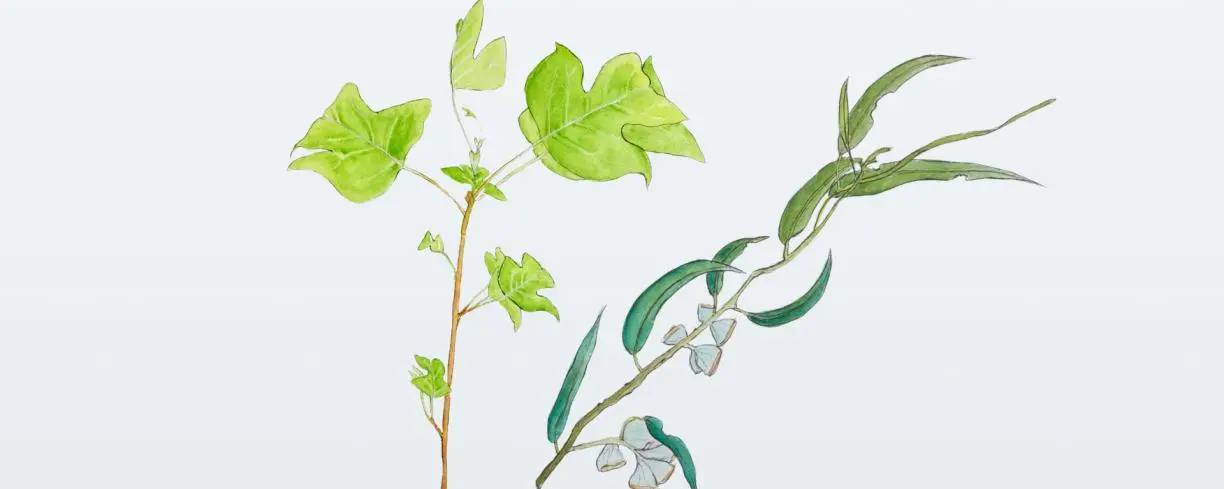
Watercolor illustration of two leafy plant sprigs.
Communication Manager

Anna Ramon Revilla

I hold a degree in Biology (2005) by the Universitat Autònoma de Barcelona, and a Master in Scientific and Environmental Communication (2007) by the Universitat Pompeu Fabra. Since 2011 I

When was the last time you really paid attention to a plant? Not just looking at it, but really observing it: the shape of its leaves, whether it has hairs, whether it smells, whether it's about to bloom, how it changes throughout the year, or how it responds to its environment.

The disconnect between people and plants has a name: plant blindness, a phenomenon that describes the human tendency not to see, recognize, or value the plants around us. A tendency that turns plants into the “green background” of our landscapes, invisible yet essential.

What is plant blindness and why is it important?

The concept of plant blindness was formulated in the late 1990s by researchers James H. Wandersee and Elisabeth Schussler, who warned us that if we don't see plants, we don't protect them either.

The causes of this condition are diverse.  Animals, including humans, are wired to detect danger and plants do not often pose an immediate threat to survival. ,Additionally, while plants are highly sensitive and reactive, their responses and movements are often harder for humans to detect compared to those of other animals.   Another contributing factor to plant blindness is that most of the human population lives in urban environments leading   to a loss of continuous contact with plants and, therefore, a reduced ability to notice the changes they undergo in response to stimuli or over time. The result is a profound paradox: plants, which make life on Earth possible, often go unnoticed. 

Woman smiles, posing near red flowers and green plants.

“Plant blindness is worrying because of the intrinsic value of plants and the increasing threats they face, and because theyare fundamental for life on earth. Plants regulate the climate, sustain biodiversity and ecosystem function, make our food, buildings. They contribute to our physical and emotional wellbeing in many ways” says Dr Kate Johnson, a postdoctoral researcher at CREAF and creator of art-science competition FLOh!RA, described below. 

Kate Johnson, postdoctoral researcher at CREAF

Forests, fields, urban trees and wild plants do not just shape landscapes: they are the foundation of the systems that sustain life. Understanding what they are, how they function and what challenges they face is essential in the current context of climate change and environmental degradation. 

Art as a tool to relearn how to observe plants

Combating plant blindness does not necessarily mean learning scientific names, but rather changing the way we look and think. In this sense, art is a powerful tool: it invites us to observe slowly, to pause and to build an emotional relationship with what we so often ignore. Through art,we can open  new ways of connecting science, emotion and environmental awareness.

This is the driving idea behind the FLOh!RA competition: inviting everyone to reconnect with plants and recognise them as sensitive, dynamic and important beings through an artistic creation.  


Logo: "Flora" in colorful letters, with floral border.

FLOh!RA is an art competition inspired by plants and science, open to people currently living in Catalonia, of all  backgrounds and abilities. This competition encourages participants to observe the plants around them, to notice how they change, and to reflect on the challenges they face. FLOh!RA  invites you to submit a piece of work addressing an aspect of how plants change in response to their environments in any format that can be received online. Formats may include: :

  1. A written text, such as a short essay or poem (up to 500 words)
  2. A video (up to 5 minutes)
  3. A work of visual art, such as a photograph, painting, or sculpture (which must be accompanied by a title and 100-word text)
  4. A song (up to 2 minutes)

Entries will be evaluated according to the originality of the artwork, evidence of research and understanding of an aspect of how plants change, as well as the creativity, clarity and effectiveness by which the idea is communicated. Prizes will be awarded for numerous categories and these will be purchased from local artists and businesses. See the FLOh!RA website for more details.

Key dates to participate in the FLOh!RA contest

  • Competition opening: February 6, 2026
  • Submission deadline: April 6, 2026

Awards ceremony, exhibition and free screening of the documentary The Giants

  • May 18, 2026, coinciding with International Plant Fascination Day

WITH THE COLLABORATION OF: