Regenerative agriculture with an international scope
The MedCREAF programme has recently focused a significant part of its activities on regenerative agriculture and soil restoration in the Mediterranean basin. This work takes shape, on the one hand, through an alliance between science and international cooperation and, on the other, through the co-organisation of an international press visit to several facilities in collaboration with the Catalunya Internacional Foundation and CERCA.
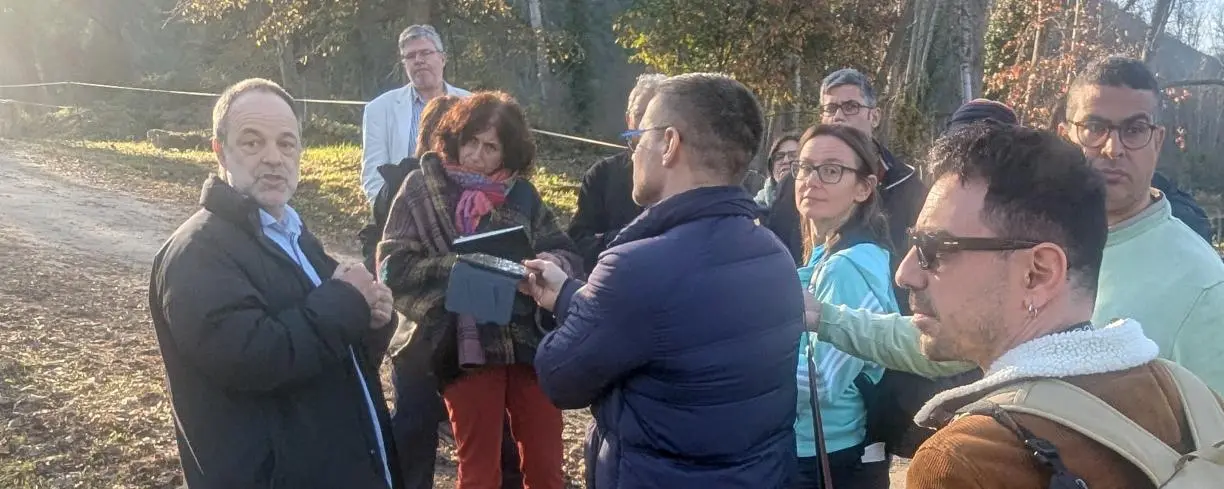
The diversity of scientific approaches to agroeconomics was the common thread of a recent visit to Catalonia by a group of 14 international journalists, organised through a programme promoted by the Catalunya Internacional Foundation and CERCA, with the collaboration of CREAF. The visit included the Mas Planeses farm (Girona), managed by CREAF, the Centre for Research in Agricultural Genomics (CRAG), located at the Autonomous University of Barcelona (UAB), the headquarters of the Institute for Research and Technology in Food and Agriculture (IRTA) in Caldes de Montbui, and the Barcelona Supercomputing Center – National Supercomputing Center (BSC-CNS) in Barcelona. The programme brought together professionals from Germany, Belgium, Croatia, Slovakia, Slovenia, Spain, France, the United Kingdom, Italy, Japan, Morocco and South America, and also included a meeting with the Catalan Minister for Research and Universities, Núria Montserrat Pulido.
During the visit to Mas Planeses, CREAF researchers Marc Gràcia Moya and Javier Retana explained on site what it means to manage an innovative model based on scientific criteria to maintain and improve soil health and biodiversity. The farm, located in the La Garrotxa region, is a regenerative farming operation where a no-till regenerative vegetable garden is cultivated and chickens, hens and cattle are raised, with the aim of helping fertilise the soil while benefiting from fresh pasture.

The Mas Planeses farm includes a regenerative livestock farm and a no-till vegetable garden. Image: CREAF.
First science-focused visit
First science-focused visit
This was the first time that Catalunya Internacional invited science journalists to take part in a visit included in its media outreach programme. On this occasion, the initiative focused on showcasing resilient agronomy and regenerative agriculture in the context of climate change. Topics addressed included crop adaptation to adverse climatic conditions, the opportunities offered by natural gene flow between species and even genetically modified plants, as well as how sustainable forest management can help prevent large-scale wildfires.
Since 2014, Catalunya Internacional has invited 230 foreign correspondents and journalists to gain a deeper understanding of Catalonia.