A chronicle of the first edition of Visions, a day to share perspectives for a better future
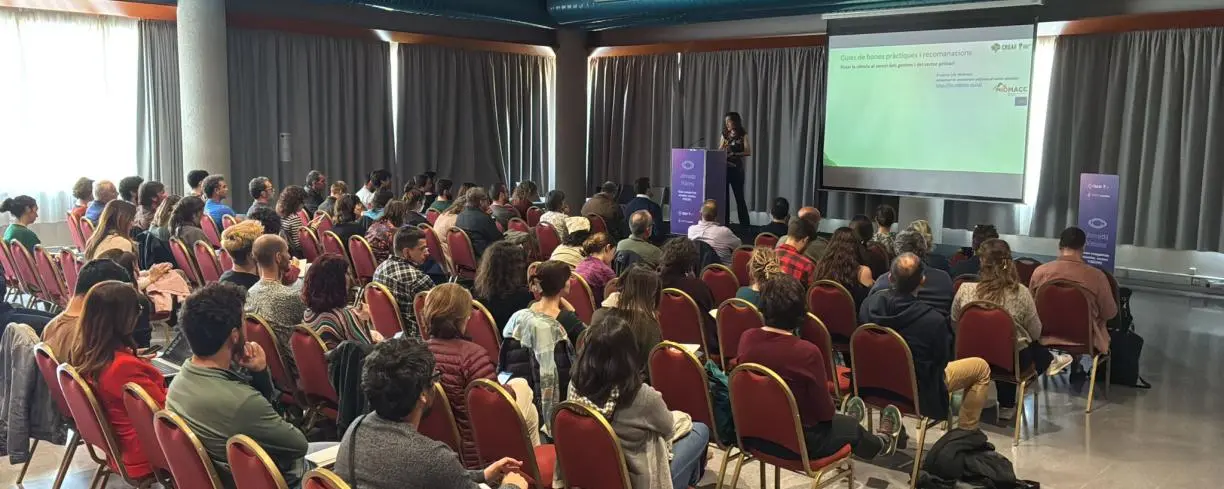
CREAF held the first edition of its Visions knowledge transfer event, dedicated to Territorial Resilience and focused on the Social and Solidarity Economy. The event took place on March 24th, from 10:00 AM to 3:00 PM, at the Exe Campus Hotel. Evelyn Segura , the excellent presenter, introduced the inspiring words of Mr. David Bonvehí Torras , Director General of Social Economy for the Government of Catalonia, who, along with Joan Pino , director of CREAF, pledged to work towards a stronger link between ecology and the social fabric.
To that end, there's nothing better than showcasing what CREAF is already doing in this area. The inspiring talks by Diana Pascual , on the adaptation of Mediterranean forests to climate change; Bernat Claramunt , who, as coordinator of NEMOR, shared his vision of Resilient Territories; and Mariona Ferrandiz , who spoke about More Resilient Cities, leveraging her role as co-creator of Replantegem, demonstrated that it's possible to work towards a future more oriented towards the common good. Their various research projects showed that co-creation with citizens, organizations, and local representatives is essential to ensuring the usefulness of the results.

Visions Day round table
The sun shone on us during coffee break as we shared our thoughts and gathered strength, because one of the most interesting moments was about to begin: the round table discussion with Rosa Binimelis from Arran de Terra, Anna Lara representing Ateneu Cooperatiu, Carles Palau from Viver Tres Turons, and Eva Vilaseca from ACTE. Among the many ideas, discussions, and debates, the most noteworthy takeaway was the proposal for a permanent working group on Social and Solidarity Economy and Science—not just ecological science—that could also act as a political force.
But the best was yet to come: the Puput Challenge. The CREAF predoctoral group joined the festivities to explain their research in the most engaging way possible. Between Filipe Manuel Andrade and his "Silent Signals," Sandra Calduch with "Operationalization of the 3-30-300 Standard," Joan Rabassa Juventeny on "The Natural Capital of Ski Resorts," and Gui Dias speaking about "Science with the People and for the People," they made it very difficult for the jury and the audience to choose the best presentation.

Luckily, we had time to think about it during the networking lunch, which was enlivened by colleagues from CREAF such as Annelies Broekman, Ester Prat, Javier Retana, Xavier Domene, Gerard Gaya, Alba Formoso, Anabel Sánchez or Olga Roig, who were ready to talk about water governance, territorial connectivity, resilient agriculture, adaptation to climate change, biodiversity conservation, citizen science and even European projects.
With their hunger and thirst for knowledge satiated, the winners of the challenge were finally announced. Gui Dias took home the grand prize of €1,000, which astonished the jury, while Joan Rabassa Juventeny won over the audience, taking home €500. Both prizes are to be used for a scientific trip.

Being able to present my research at an inspiring event like Visions and having it received so well was especially motivating. To prepare my talk, I followed the recommendations of the organizing team, who pointed out the key elements for a short presentation to connect with the audience: a good opening, clear messages, and a well-structured conclusion. And it seems I successfully applied them. I'm still considering how to invest the prize money, but I'll most likely use it to attend the British Ecological Society Annual Meeting 2026, where I want to present the second chapter of my thesis, which deals with the impact of invasive alien species in mountain areas.

It has been very rewarding to participate in Visions and even more so to have won the jury prize. I feel even more motivated to continue conducting research critically. In my opinion, the conference was very important for reflecting on the fact that science is not politically neutral and that, if we want to contribute to social transformation, we must question the implications of the capitalist system on traditional scientific practice. Furthermore, the event was important for highlighting the research of doctoral students at CREAF.

Participating in the first VISIONS knowledge transfer day was a very enriching experience. I was able to share my research on urban ecology and the rewilding of cities through the analysis of urban green infrastructure and the provision of ecosystem services. At the same time, I learned about my colleagues' research and new communication strategies for connecting with the public.

Evelyn Segura and Enrique Doblas presented the awards and closed a successful day, in which we can only thank all the participants and look forward to the next one.