
This fifth meeting was an opportunity to bring together the entire consortium, share the work we are doing at the various demonstration sites and move towards a future that uses nature-based solutions to adapt to climate change.

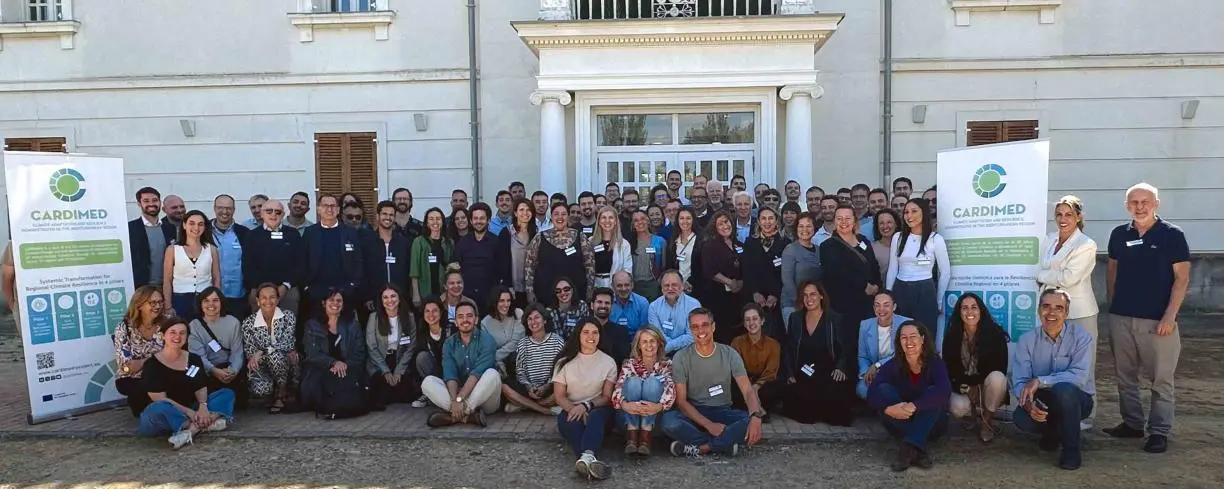
The European CARDIMED project has a dual objective: to demonstrate the potential of nature-based solutions (NBSs) to increase the resilience of Mediterranean ecosystems to new climate conditions and to build an infrastructure that allows the knowledge generated to be unified and made available to interested actors. The initiative has already been running for three years and recently all partners met in Zaragoza, Aragon (Spain), to celebrate the fifth General Assembly, the third to be held in person.
This annual meeting brought together the entire consortium to review three years of progress , address challenges and coordinate next steps in the common mission of integrating SBNs throughout the Mediterranean region.
This fifth meeting was an opportunity to bring together the entire consortium, share the work we are doing at the various demonstration sites and move towards a future that uses nature-based solutions to adapt to climate change.
In particular, CREAF sought to clarify the doubts of those responsible for implementing the different solutions regarding the monitoring plan proposed by our researchers and collaborators and the indicators specifically designed for each case.
YOU MAY ALSO BE INTERESTED IN
Sixteen case studies in seven countries
To demonstrate the effectiveness of these solutions, one of the priority objectives of the project is to implement a selection of 16 cases on the ground in 20 locations located in Greece, Italy, Portugal, France, Spain, Cyprus and Turkey . The progress made in these demonstration cases was presented at the event. Overall, the partners detected a positive balance of progress, with the achievement of most of the objectives and milestones, as well as the launch of new digital tools for SbN planning, which will soon be available to stakeholders and citizens. In fact, many are ready to enter the monitoring phase in 2026, with installations such as green walls, “sponge city” interventions, renaturalized schools, microforests and smart water management systems , which are already starting to deliver results.
YOU MAY ALSO BE INTERESTED IN
Field trips to Aragon
Beyond the presentations, the consortium participated in field visits to observe these solutions in action. For example, the partners visited the Espai Alfranca, one of the most emblematic agro-environmental farms in Aragon, which combines historical, cultural and natural heritage.
They also traveled to Alcañiz (Teruel), to visit the Juan de Sobrarías School, where the participants learned about the Patios for the Climate program, which includes renaturalized school recesses with organic gardens, chicken coops, ponds and outdoor classrooms.
The visit concluded in the forests of Teruel, where a solution focused on the management of a mistletoe pest is being implemented. There, the partners reviewed in situ the mapping and monitoring of the spread of mistletoe over 20 years, the available data on the current state of the pest obtained during the project through LIDAR and multispectral drone flights, and the control measures planned as SbN.

Field visit during the fifth meeting of the CARDIMED project, Zaragoza. Authorship: CARDIMED project.
The 5th General Assembly in Zaragoza reaffirmed CARDIMED's role as a Mediterranean benchmark in climate resilience . For three days, partners worked side by side, shared learnings and strengthened ties as a community. The meeting highlighted the project's capacity to offer concrete solutions, inspire replication and connect science with society.
WITH THE COLLABORATION OF: